Briefly on a Blues Legend:
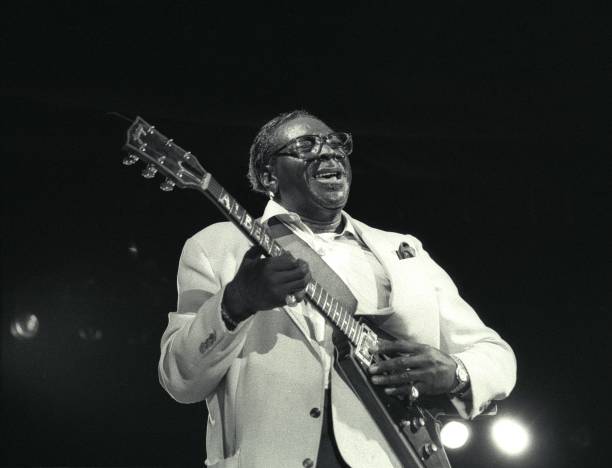
Albert King (AK) died on December 21, 1992. He was without a doubt the blues musician who influenced rock players the most{1} and he did this despite a technique that was uniquely his own -including tuning down the guitar a whole step and playing a right handed guitar left handed resulting in the strings being reversed. As a result of this, the strings most players pushed he pulled at and his ability to generate the crying sound that epitomizes the blues through bending was without parallel.{2} He was not a flashy player nor did he play very fast but he compensated for this with focus on all the other elements that go into being a well rounded player and sadly enough, these are areas that most players take little if any notice of.
Jimi Hendrix who is usually considered one of (if not the) best guitar players in history was terrified to stand onstage with King{3} as indeed anyone who was sane would be when AK was having a good night.{4} For the man known as "The Velvet Bulldozer" had such power and intensity in his playing but was also capable of playing very delicately with careful note inflections. His vibrato was first rate and he had a certain sass{5} to his approach which coupled with his tremendous size made for an imposing stage presence.
May he rest in peace.
Notes:
{1} He was put in the Rock and Roll Hall of Fame in 2013.
{2} BB King noted in his own autobiography (not long before he noted that AK was "not my brother in blood but he was surely my brother in blues") that AK was able to bend notes in a way that would absolutely cut you in half.
{3} I am unaware of any other musician who could make this claim but then again, it was more than his style of playing that was intimidating but the man himself who stood six and a half feet tall and weighed a good 250 when in his prime.
{4} "I can't think of anybody who would go out onstage with Albert on a good night and not be absolutely terrified to play the blues next to him. That guy'll run over you like Amtrak." [Joe Walsh in Guitar World]
{5} "I don't know of anybody who can play sassier than Albert." [Stevie Ray Vaughan in Guitar World]
Showing posts with label The Blues. Show all posts
Showing posts with label The Blues. Show all posts
Thursday, April 23, 2009
Miscellaneous Musings:
To touch briefly on a few subjects...
--I must admit I am surprised and very pleasantly so that the Seattle Mariners are off to such a splendid start. Principles I have long said this team needs to embrace to work best with the kinds of talent they have are being realized -hats off to the new general manager Jack Zduriencik for the hiring of Don Wakamatsu as the new coach. I look forward to the M's actually being a competitive team this year for the first time since the departure of "Sweet" Lou Piniella.
--I am working at the moment on a text to respond to both the recent release by the Obama Administration of certain so-called "torture memos" and also to address certain predictable parties with regards to their continuing promotion of irrationality and unethical evasions on these matters under the presumed mantle of some "higher morality" or whatever pretenses they attempt to cloak themselves in to confuse not a few people. I anticipate it will be done next week -it is substantially completed in draft form now but needs review and also perhaps a few more tidbits added. I intend with the text to point to some past statements and principles I have set down in greater expository fashion but for this text to be briefer and more concise than other treatments on this matter have been.
--Today is the anniversary of the birth of blues legend Albert King. I originally intended to finish a tribute I was writing last December to commemorate the anniversary of his passing for this occasion but was unable to for various and sundry reasons. I will therefore leave that draft for finishing hopefully by December if I have the time and inclination and will point the readers to a review I wrote for two of his albums on Amazon.com in years past and also what I wrote back in December of 2007 on the man and his music:
Musings on the 40th Anniversary of Born Under a Bad Sign (circa December 21, 2007)
In Session --Rough Draft of Eventual Amazon Book Review (circa January 20, 2006)
Live (written for Amazon in 2001; slightly revised today)
Rest in peace "Velvet Bulldozer"
To touch briefly on a few subjects...
--I must admit I am surprised and very pleasantly so that the Seattle Mariners are off to such a splendid start. Principles I have long said this team needs to embrace to work best with the kinds of talent they have are being realized -hats off to the new general manager Jack Zduriencik for the hiring of Don Wakamatsu as the new coach. I look forward to the M's actually being a competitive team this year for the first time since the departure of "Sweet" Lou Piniella.
--I am working at the moment on a text to respond to both the recent release by the Obama Administration of certain so-called "torture memos" and also to address certain predictable parties with regards to their continuing promotion of irrationality and unethical evasions on these matters under the presumed mantle of some "higher morality" or whatever pretenses they attempt to cloak themselves in to confuse not a few people. I anticipate it will be done next week -it is substantially completed in draft form now but needs review and also perhaps a few more tidbits added. I intend with the text to point to some past statements and principles I have set down in greater expository fashion but for this text to be briefer and more concise than other treatments on this matter have been.
--Today is the anniversary of the birth of blues legend Albert King. I originally intended to finish a tribute I was writing last December to commemorate the anniversary of his passing for this occasion but was unable to for various and sundry reasons. I will therefore leave that draft for finishing hopefully by December if I have the time and inclination and will point the readers to a review I wrote for two of his albums on Amazon.com in years past and also what I wrote back in December of 2007 on the man and his music:
Musings on the 40th Anniversary of Born Under a Bad Sign (circa December 21, 2007)
In Session --Rough Draft of Eventual Amazon Book Review (circa January 20, 2006)
Live (written for Amazon in 2001; slightly revised today)
Rest in peace "Velvet Bulldozer"


Wednesday, April 01, 2009
Friday, September 05, 2008
Remembering a Music Legend:
As yesterday was the anniversary of the birth of blues master Freddie King{1}, I wanted to take a moment and remind readers of what I wrote on this occasion two years ago:
"Palace of the King" Dept. -A Tribute to Freddie (circa September 3, 3006)
I do not have much more to say at the moment than what was noted there though I do want to put a picture to words as well so here is Freddie in a 1973 live performance of one of his classics Have You Ever Loved A Woman. Enjoy!!!
Rest in Peace "Texas Cannonball"...
As yesterday was the anniversary of the birth of blues master Freddie King{1}, I wanted to take a moment and remind readers of what I wrote on this occasion two years ago:
"Palace of the King" Dept. -A Tribute to Freddie (circa September 3, 3006)
I do not have much more to say at the moment than what was noted there though I do want to put a picture to words as well so here is Freddie in a 1973 live performance of one of his classics Have You Ever Loved A Woman. Enjoy!!!
Rest in Peace "Texas Cannonball"...
Thursday, August 28, 2008
If I wrote every year on the birthdays or the passing of those in my family, close friends, figures of varying influence in my life, there would be nothing else to write about.{1} Serendipitously, I remember some of them regularly and others not so much so but for some reason, I remembered the other day that Stevie Ray Vaughan (SRV) passed on in August of 1990 at the age of 35 when a helicopter he was flying in crashed in Alpine Valley, Wisconsin. I checked and noticed the date which happens to be today and decided it would be fitting therefore to remember him in some fashion. I will do so in two ways, the first of which is posting the lyrics to a song Jimmie Vaughan co-write with some of the Neville brothers in remembering his brother called Six Strings Down. Without further ado...
Alpine valley
In the middle of the night
Six strings down
On the heaven-bound flight
Got a pick, a strap, guitar on his back
Ain’t gonna cut the angels no slack
Heaven done called
Another blues-stringer back home
See the voodoo chile
Holding out his hand
I’ve been waitin’ on you brother
Welcome to the band
Good blues-stringin’
Heaven-fine singin’
Jesus, Mary and Joseph
Been lis’nin’ to your playin’
Heaven done called
Another blues-stringer back home
Lord they called
Another blues-stringer back home
Albert Collins up there
Muddy an’ Lightnin’ too
Albert King and Freddy
Playin’ the blues
T-Bone Walker, Guitar Slim
Little Son Jackson and
Frankie Lee Sims
Heaven done called
Another blues-stringer back home
Lord they called
Another blues-stringer back home
Lord they called
Another blues-stringer back home
Heaven done called
Another blues-stringer back home
Lord they called...
The second way is with a video of his performing. In pondering which one to use, I decided to use this one of SRV with his childhood hero Albert King{2} playing Stevie Ray's original composition Pride and Joy circa December 1983{3} from an album I reviewed here.
May they rest in peace.
[Update: I accidentally used the code for another shorter instrumental outtake jam from Blues at Sunrise rather than the one from Pride and Joy. I apologize for that and will add the code for the latter performance to this posting as well below this text. -ISM 8/28/08 10:57pm]
Notes:
{1} I do not want to discuss this matter right now except to say that I realized the other day when talking with my mother that I had significantly underestimated both the number of familia and friends deaths the past eight and a half years but also the number of funerals I had attended in that span. I may say more some other time on that but after a while it all blurs together (unfortunately).
{2} Albert died in 1992 at the age of 69 and is also mentioned in Six Strings Down.
{3} This was not long after SRV released his debut album Texas Flood.
Alpine valley
In the middle of the night
Six strings down
On the heaven-bound flight
Got a pick, a strap, guitar on his back
Ain’t gonna cut the angels no slack
Heaven done called
Another blues-stringer back home
See the voodoo chile
Holding out his hand
I’ve been waitin’ on you brother
Welcome to the band
Good blues-stringin’
Heaven-fine singin’
Jesus, Mary and Joseph
Been lis’nin’ to your playin’
Heaven done called
Another blues-stringer back home
Lord they called
Another blues-stringer back home
Albert Collins up there
Muddy an’ Lightnin’ too
Albert King and Freddy
Playin’ the blues
T-Bone Walker, Guitar Slim
Little Son Jackson and
Frankie Lee Sims
Heaven done called
Another blues-stringer back home
Lord they called
Another blues-stringer back home
Lord they called
Another blues-stringer back home
Heaven done called
Another blues-stringer back home
Lord they called...
The second way is with a video of his performing. In pondering which one to use, I decided to use this one of SRV with his childhood hero Albert King{2} playing Stevie Ray's original composition Pride and Joy circa December 1983{3} from an album I reviewed here.
May they rest in peace.
[Update: I accidentally used the code for another shorter instrumental outtake jam from Blues at Sunrise rather than the one from Pride and Joy. I apologize for that and will add the code for the latter performance to this posting as well below this text. -ISM 8/28/08 10:57pm]
Notes:
{1} I do not want to discuss this matter right now except to say that I realized the other day when talking with my mother that I had significantly underestimated both the number of familia and friends deaths the past eight and a half years but also the number of funerals I had attended in that span. I may say more some other time on that but after a while it all blurs together (unfortunately).
{2} Albert died in 1992 at the age of 69 and is also mentioned in Six Strings Down.
{3} This was not long after SRV released his debut album Texas Flood.
Saturday, December 22, 2007
Commemorating a Blues Classic:
(Musings of your humble servant at Rerum Novarum)
Born Under A Bad Sign Turns 40
As today is the fifteenth anniversary of the passing of blues legend Albert King (1923-1992), it seems appropriate to say something of note on that anniversary and another milestone to which he will forever be associated with. But first a small bit from the above link:
Born Under A Bad Sign was unlike any blues album that came before—or since. And four decades after its release, guitarists everywhere are still reeling.
To start with, the actual birthday of the album was back in August but for all the talk about the music of the "Summer of Love" and the great albums released that year from The Beatles, Cream, Jimi Hendrix, and countless others,{1} one album that has consistently not been mentioned was blues legend Albert King's seminal 1967 album Born Under A Bad Sign.
Rarely has an album been released that completely redefined an entire genre of music (in this case, the blues) and had influence radiating beyond its genre. Furthermore, it is rare that a musician who forged his own unique style and innovated his own licks to have had so many licks stolen -both consciously as well as unconsciously- by fellow musicians who generally received greater recognition than him.
Eric Clapton was lauded as "God" in Britain as far back as 1965 when he was reproducing licks from Albert King's Bobbin Records sessions of the late 1950's and early 1960's. Jimi Hendrix would put his guitar down and pick up a bass to back up King on stage so he could study the man's technique which was wholly original. Fellow blues titans who had reached acclaim and wider audiences when King was still toiling in relative obscurity (i.e. Otis Rush, Freddie King) and who both had earlier influential hits and later significant successes (i.e. Albert Collins) to a man noticeably revamped their styles of play as a result of King's influence.
Clapton's work on Cream's two biggest albums (particularly 1967's Disraeli Gears) and Jimi Hendrix's Are You Experienced? and subsequent albums have so many copped licks from King (including at times solos nearly note for note) that they should have paid the man royalties.{2} Albert King was also the only bluesmen of that era who consistently sold equally to both black and white listening audiences without changing the fundamentals of his playing style an iota. But while not changing in the fundamentals, he did nonetheless show a capacity for applying his playing style to a variety of rhythmic stylings.
His earliest recordings for Bobbin in the late 1950's for example had more of a swinging jazz approach to them and this carried a bit into the early 1960's. By the mid 1960's, he was the only bluesman on the St. Louis-based Stax label and recording singles with the rhythmic backing of Booker T. and the MG's. After the breakout of Born Under A Bad Sign and a slew of live performances that followed, King at the age of 43 finally crossed over to the white audience and solidified blues as not a dying form but one which was vibrant, living, and adaptable.
This carried into the early 1970's where when funk came about, he utilized funk rhythms and later even some disco rhythms on albums from the late 1970's. But despite those things, the core of his style never changed and he continued to sell about evenly to black and white audiences. This is significant because better known blues musicians (such as BB King) did not accomplish the same feat.{3} He continued to play concerts all the way up to the end of his life with what he may have lost in the final year of his life{4} being minor at best.
Blues would not sound the way it does today if not for Albert King. The same is the case for rock and roll, for "heavy metal", or any other genre you could mention from that time. So for that reason alone, Albert King deserves to be remembered and on this the fifteenth anniversary of his passing and the fortieth anniversary year of THE most important blues album of the past fifty years (if not of all time), that is what we intend to do here at Rerum Novarum.
The video below is from a DVD titled Albert King Live in Sweden from 1980 which suffers from being way too short and the song below being broken up in the middle with an interview which would have been better either at the beginning or end of the song. Oh well, you can still catch from the parts you can hear some of the elements behind his unique approach to playing and singing. The man just oozed soul with every note played as a statement unto itself -something these guitar shredder types completely miss. Nonetheless...
Rest in peace Albert.
Notes:
{1} 1967 was also the year of debut albums by Pink Floyd and The Grateful Dead.
{2} The biggest culprit in this area was Stevie Ray Vaughan but Vaughan was also the most generous of the bunch -never failing to give Albert King his due as the significant cornerstone influence in Vaughan's own style of play. For more on the relationship between these two, see this album review we posted back in January of 2006.
{3} Well in BB's case, he did with his 1970 hit The Thrill is Gone but that was an exception to the rule.
{4} He lost a lot of weight in his final year due to diabetes and that coupled with a bit of hearing loss affected his playing a bit at that time.
(Musings of your humble servant at Rerum Novarum)
Born Under A Bad Sign Turns 40
As today is the fifteenth anniversary of the passing of blues legend Albert King (1923-1992), it seems appropriate to say something of note on that anniversary and another milestone to which he will forever be associated with. But first a small bit from the above link:
Born Under A Bad Sign was unlike any blues album that came before—or since. And four decades after its release, guitarists everywhere are still reeling.
To start with, the actual birthday of the album was back in August but for all the talk about the music of the "Summer of Love" and the great albums released that year from The Beatles, Cream, Jimi Hendrix, and countless others,{1} one album that has consistently not been mentioned was blues legend Albert King's seminal 1967 album Born Under A Bad Sign.
Rarely has an album been released that completely redefined an entire genre of music (in this case, the blues) and had influence radiating beyond its genre. Furthermore, it is rare that a musician who forged his own unique style and innovated his own licks to have had so many licks stolen -both consciously as well as unconsciously- by fellow musicians who generally received greater recognition than him.
Eric Clapton was lauded as "God" in Britain as far back as 1965 when he was reproducing licks from Albert King's Bobbin Records sessions of the late 1950's and early 1960's. Jimi Hendrix would put his guitar down and pick up a bass to back up King on stage so he could study the man's technique which was wholly original. Fellow blues titans who had reached acclaim and wider audiences when King was still toiling in relative obscurity (i.e. Otis Rush, Freddie King) and who both had earlier influential hits and later significant successes (i.e. Albert Collins) to a man noticeably revamped their styles of play as a result of King's influence.
Clapton's work on Cream's two biggest albums (particularly 1967's Disraeli Gears) and Jimi Hendrix's Are You Experienced? and subsequent albums have so many copped licks from King (including at times solos nearly note for note) that they should have paid the man royalties.{2} Albert King was also the only bluesmen of that era who consistently sold equally to both black and white listening audiences without changing the fundamentals of his playing style an iota. But while not changing in the fundamentals, he did nonetheless show a capacity for applying his playing style to a variety of rhythmic stylings.
His earliest recordings for Bobbin in the late 1950's for example had more of a swinging jazz approach to them and this carried a bit into the early 1960's. By the mid 1960's, he was the only bluesman on the St. Louis-based Stax label and recording singles with the rhythmic backing of Booker T. and the MG's. After the breakout of Born Under A Bad Sign and a slew of live performances that followed, King at the age of 43 finally crossed over to the white audience and solidified blues as not a dying form but one which was vibrant, living, and adaptable.
This carried into the early 1970's where when funk came about, he utilized funk rhythms and later even some disco rhythms on albums from the late 1970's. But despite those things, the core of his style never changed and he continued to sell about evenly to black and white audiences. This is significant because better known blues musicians (such as BB King) did not accomplish the same feat.{3} He continued to play concerts all the way up to the end of his life with what he may have lost in the final year of his life{4} being minor at best.
Blues would not sound the way it does today if not for Albert King. The same is the case for rock and roll, for "heavy metal", or any other genre you could mention from that time. So for that reason alone, Albert King deserves to be remembered and on this the fifteenth anniversary of his passing and the fortieth anniversary year of THE most important blues album of the past fifty years (if not of all time), that is what we intend to do here at Rerum Novarum.
The video below is from a DVD titled Albert King Live in Sweden from 1980 which suffers from being way too short and the song below being broken up in the middle with an interview which would have been better either at the beginning or end of the song. Oh well, you can still catch from the parts you can hear some of the elements behind his unique approach to playing and singing. The man just oozed soul with every note played as a statement unto itself -something these guitar shredder types completely miss. Nonetheless...
Rest in peace Albert.
Notes:
{1} 1967 was also the year of debut albums by Pink Floyd and The Grateful Dead.
{2} The biggest culprit in this area was Stevie Ray Vaughan but Vaughan was also the most generous of the bunch -never failing to give Albert King his due as the significant cornerstone influence in Vaughan's own style of play. For more on the relationship between these two, see this album review we posted back in January of 2006.
{3} Well in BB's case, he did with his 1970 hit The Thrill is Gone but that was an exception to the rule.
{4} He lost a lot of weight in his final year due to diabetes and that coupled with a bit of hearing loss affected his playing a bit at that time.
Sunday, October 14, 2007
On Blogging in General, My Approaches To It, Remembering Two Musical Legends and Three Major Influences, Etc:
(Musings of your humble servant at Rerum Novarum)
[This thread was predominantly drafted back in early September but due to time constraints was not able to be finished until now. -ISM]
I would be remiss in not mentioning at the start of these musings that September 3rd was the birthday of blues legend Freddy King. I wrote in some length on him last year and encourage readers to review that thread to learn more{1} about the late great "Texas Cannonball" (may he rest in peace).
On the subject of blogging, there are many ways of going about writing on a blog or in other online mediums. I have gone over this a few times in the past and probably will in the future the approaches I use to draw ideas for blogging. One of them is that I am by nature a bit of a contrarian and always have been. That in and of itself is a departure from most people but frankly if you are not to some extent unique -either in your views, your approach to explaining your views, how you go about discussing the subjects you want to discuss, etc.- then it is difficult to be perceived apart from the general mass of those with similarities in their outlooks as yours.
The blogging medium itself is one that I consciously recognized early on{2} had a number of ways to do it and I did not want to approach the way many others do. Or as was noted in a weblog posting within the first year of blogging and when the weblog was still in an early part of its growth:
[Blogging a bunch of links] is not something that interests me for many reasons - though I do have my days on occasion when I am in the mood to mostly post links without much commentary.
...
I can track stuff down with the best of them but my problem is that I cannot simply post a lot of links and not comment on them. And my reason for this is [due to] the tendencies of the media to try and paint people [of a generally conservative disposition] as either criminal or weird. And if I can do my part to make "a dent in public discourse" then I will do that. But one way I cannot do that is to simply be a vending machine of links.
For if I did do that too regularly, why would I provide any incentive to actually read Rerum Novarum and not Instapundit??? And why read Instapundit and not the two columns on the front page of Investors Business Daily??? I could deconstruct this into near-infinity so I will stop at this time as I am sure you get the idea. My goal is simply to muse on whatever strikes my fancy. In short, there is a reason that you will seldom see breaking stories at this humble weblog.[...]
I tend to prefer to let others bring up breaking issues and then I respond to them. There are tactical reasons for this as well as practical ones. Part of the reason is that I am too critical of journalism in general of rushing to print anything they think can make a story and then if they err on A1 - which happens more frequently than most people would believe, they correct themselves on Q14 where no one sees it.[...]
I find if I let others break the story, I can benefit from their efforts and also circumvent the problems that can come with seeking to "break" a story before anyone else. And of course letting others hash out the main points provides an opportunity to approach the subjects in a way that is to some degree different than anyone else.
...
Criticism is sometimes justified but usually those who make a habit of it are incapable of separating legitimate criticism from childlike rantings. I believe we do a reasonable job of that separation here; however that does not mean there is no room for improvement of course. [Excerpt from Rerum Novarum (circa June 11, 2003)]
I should probably note that even early on I was not predisposed to post a lot of links without commentary but I did it to a greater extent early on than I subsequently have. There are a few reasons for this but rather than go into that now, there are many strengths to the approach I take. One is that it makes it easier to focus on the real underlying issues of a subject and not so much of the trivial surface stuff that most people focus on. However, one of the problems with imposing on oneself a degree of contemporary ignorance of media overexposure is that stuff one would be interested in if they heard of it gets lost as well. The strengths I could list for my overall approach to these matters are legion. The weaknesses while few are nonetheless worth noting and I will give three such examples at this time of news stories I did not hear of until weeks after the fact.
The first example is this thread from the New York Times froma couple of weeks two months ago:
Max Roach, a Founder of Modern Jazz, Dies at 83
Now the only reason I know of this link is that I saw on the cover of a jazz periodical at the library an article about the late great Max Roach, God rest his soul. That got me to do a google search and the above article was found on him. I am a music connoisseur of many styles but one style I like where my overall knowledge is not that good is jazz. Having said that though, one cannot be even minimally familiar with jazz and not know about Max Roach. He was unquestionably the greatest jazz drummer ever. Indeed, his influence went beyond jazz with some of the greatest rock and roll drummers of the '60s and '70s being unquestionably influenced by Roach either directly (i.e Ginger Baker and Neil Peart) or indirectly (i.e. John Bonham, Keith Moon).
Within the last couple ofdays weeks we saw pass on also the greatest tenor since Enrico Caruso, Luciano Pavarotti. As he is much better known than Max Roach, I will not say much on him that has not been said by others far more competent to discuss that genre of music than myself. I refer of course to fellow musicians including his opera peers and fellow Three Tenors performer Jose Carraras and Placido Domingo who were involved in a musical memorial and who (along with numerous others) spoke fondly of him here. And it seems fitting to include a clip of the great Pavarotti (RIP) so here is one of him singing Nessun Dorma. In three words: he was phenomenal.
Also a missed news story in that time span was the death of Michael Jackson (may he rest in peace). Those familiar with your host's love of beer, wine, and other spirits may well know whom I speak of -suffice to say it is not the same fella who owns Neverland Ranch. Lovers of fine beer will hopefully join me in lifting a glass to his memory -if not for Michael Jackson and the world of fine imports he either exposed me to or encouraged me to seek out and try, my knowledge of beer would be so much less than it is to say nothing of my appreciation for the truly good stuff which is most assuredly not made in America.{3}
Finally, there is the passing of Arthur Jones -founder of Nautilus and a certified renaissance man in many respects. The influence he had on my intellectual formation -both directly and particularly by the influence he had on one of my major intellectual mentors- cannot be emphasized enough. He was one of those who taught me and others who fell under the sway of his influence to not passively accept "conventional wisdom" on anything and indeed that lesson (learned at a young age thankfully) has served me well lo these many years later.
It is my hope that these great men (both the recently as well as not-so-recently deceased) will rest peacefully with the souls of the faithfully departed in the bosom of God for their utilization of the tremendous gifts they gave to others. Perhaps if I had been a little less media ignorant than I had been in the past couple of months{4} I would have caught these events sooner. But even if I had been, the possibility of missing them was still a significant one and considering how much garbage one has to sift through to find the wheat amongst the chaff. (Due to the overstressing nature of 24/7 news cycles.)
Notes:
{1} For those interested in more about Freddy King, here and here are a couple links of him playing live.
{2} After I adjusted to it and the degree of freedom here which as I admitted back in May did not happen automatically or without a degree of "growing pains":
[L]ife itself is a process of growth and development across a broad continuum. This includes weblog writing and interests.
We have no problem admitting that it took a bit of time before this weblog really started to take a discernable shape and some of the features and/or principles which have become standard or typical over time were in the "finding their feet" stage early on. [Excerpt from Rerum Novarum (circa May 15, 2007)]
{3} This is not to deprecate some of the microbrews that are made in various locales mind you; only that my operative presupposition with beer is that foreign brews are to be preferred whenever possible except for Japanese beer which has the singular distinction of being the only nation where the mass-produced beers are worse than those made in America.
{4} I have been gradually imposing a greater media ignorance on myself than I normally have and deliberately for reasonsI may touch on at some point later on. I have actually explained recently.
(Musings of your humble servant at Rerum Novarum)
[This thread was predominantly drafted back in early September but due to time constraints was not able to be finished until now. -ISM]
I would be remiss in not mentioning at the start of these musings that September 3rd was the birthday of blues legend Freddy King. I wrote in some length on him last year and encourage readers to review that thread to learn more{1} about the late great "Texas Cannonball" (may he rest in peace).
On the subject of blogging, there are many ways of going about writing on a blog or in other online mediums. I have gone over this a few times in the past and probably will in the future the approaches I use to draw ideas for blogging. One of them is that I am by nature a bit of a contrarian and always have been. That in and of itself is a departure from most people but frankly if you are not to some extent unique -either in your views, your approach to explaining your views, how you go about discussing the subjects you want to discuss, etc.- then it is difficult to be perceived apart from the general mass of those with similarities in their outlooks as yours.
The blogging medium itself is one that I consciously recognized early on{2} had a number of ways to do it and I did not want to approach the way many others do. Or as was noted in a weblog posting within the first year of blogging and when the weblog was still in an early part of its growth:
[Blogging a bunch of links] is not something that interests me for many reasons - though I do have my days on occasion when I am in the mood to mostly post links without much commentary.
...
I can track stuff down with the best of them but my problem is that I cannot simply post a lot of links and not comment on them. And my reason for this is [due to] the tendencies of the media to try and paint people [of a generally conservative disposition] as either criminal or weird. And if I can do my part to make "a dent in public discourse" then I will do that. But one way I cannot do that is to simply be a vending machine of links.
For if I did do that too regularly, why would I provide any incentive to actually read Rerum Novarum and not Instapundit??? And why read Instapundit and not the two columns on the front page of Investors Business Daily??? I could deconstruct this into near-infinity so I will stop at this time as I am sure you get the idea. My goal is simply to muse on whatever strikes my fancy. In short, there is a reason that you will seldom see breaking stories at this humble weblog.[...]
I tend to prefer to let others bring up breaking issues and then I respond to them. There are tactical reasons for this as well as practical ones. Part of the reason is that I am too critical of journalism in general of rushing to print anything they think can make a story and then if they err on A1 - which happens more frequently than most people would believe, they correct themselves on Q14 where no one sees it.[...]
I find if I let others break the story, I can benefit from their efforts and also circumvent the problems that can come with seeking to "break" a story before anyone else. And of course letting others hash out the main points provides an opportunity to approach the subjects in a way that is to some degree different than anyone else.
...
Criticism is sometimes justified but usually those who make a habit of it are incapable of separating legitimate criticism from childlike rantings. I believe we do a reasonable job of that separation here; however that does not mean there is no room for improvement of course. [Excerpt from Rerum Novarum (circa June 11, 2003)]
I should probably note that even early on I was not predisposed to post a lot of links without commentary but I did it to a greater extent early on than I subsequently have. There are a few reasons for this but rather than go into that now, there are many strengths to the approach I take. One is that it makes it easier to focus on the real underlying issues of a subject and not so much of the trivial surface stuff that most people focus on. However, one of the problems with imposing on oneself a degree of contemporary ignorance of media overexposure is that stuff one would be interested in if they heard of it gets lost as well. The strengths I could list for my overall approach to these matters are legion. The weaknesses while few are nonetheless worth noting and I will give three such examples at this time of news stories I did not hear of until weeks after the fact.
The first example is this thread from the New York Times from
Max Roach, a Founder of Modern Jazz, Dies at 83
Now the only reason I know of this link is that I saw on the cover of a jazz periodical at the library an article about the late great Max Roach, God rest his soul. That got me to do a google search and the above article was found on him. I am a music connoisseur of many styles but one style I like where my overall knowledge is not that good is jazz. Having said that though, one cannot be even minimally familiar with jazz and not know about Max Roach. He was unquestionably the greatest jazz drummer ever. Indeed, his influence went beyond jazz with some of the greatest rock and roll drummers of the '60s and '70s being unquestionably influenced by Roach either directly (i.e Ginger Baker and Neil Peart) or indirectly (i.e. John Bonham, Keith Moon).
Within the last couple of
Also a missed news story in that time span was the death of Michael Jackson (may he rest in peace). Those familiar with your host's love of beer, wine, and other spirits may well know whom I speak of -suffice to say it is not the same fella who owns Neverland Ranch. Lovers of fine beer will hopefully join me in lifting a glass to his memory -if not for Michael Jackson and the world of fine imports he either exposed me to or encouraged me to seek out and try, my knowledge of beer would be so much less than it is to say nothing of my appreciation for the truly good stuff which is most assuredly not made in America.{3}
Finally, there is the passing of Arthur Jones -founder of Nautilus and a certified renaissance man in many respects. The influence he had on my intellectual formation -both directly and particularly by the influence he had on one of my major intellectual mentors- cannot be emphasized enough. He was one of those who taught me and others who fell under the sway of his influence to not passively accept "conventional wisdom" on anything and indeed that lesson (learned at a young age thankfully) has served me well lo these many years later.
It is my hope that these great men (both the recently as well as not-so-recently deceased) will rest peacefully with the souls of the faithfully departed in the bosom of God for their utilization of the tremendous gifts they gave to others. Perhaps if I had been a little less media ignorant than I had been in the past couple of months{4} I would have caught these events sooner. But even if I had been, the possibility of missing them was still a significant one and considering how much garbage one has to sift through to find the wheat amongst the chaff. (Due to the overstressing nature of 24/7 news cycles.)
Notes:
{1} For those interested in more about Freddy King, here and here are a couple links of him playing live.
{2} After I adjusted to it and the degree of freedom here which as I admitted back in May did not happen automatically or without a degree of "growing pains":
[L]ife itself is a process of growth and development across a broad continuum. This includes weblog writing and interests.
We have no problem admitting that it took a bit of time before this weblog really started to take a discernable shape and some of the features and/or principles which have become standard or typical over time were in the "finding their feet" stage early on. [Excerpt from Rerum Novarum (circa May 15, 2007)]
{3} This is not to deprecate some of the microbrews that are made in various locales mind you; only that my operative presupposition with beer is that foreign brews are to be preferred whenever possible except for Japanese beer which has the singular distinction of being the only nation where the mass-produced beers are worse than those made in America.
{4} I have been gradually imposing a greater media ignorance on myself than I normally have and deliberately for reasons
Monday, April 23, 2007
As today would have been the 84th birthday of Albert King -a man who was one of the greatest innovators and influences in postwar electric blues, I want to recognize this event with posting a video from YouTube. In this video is Albert, his greatest disciple Stevie Ray Vaughan, and Paul Butterfield of the Paul Butterfield Blues Band fame playing an Elmore James classic The Sky is Crying.
The Sky is Crying
May all three of them rest in peace.
The Sky is Crying
May all three of them rest in peace.
Tuesday, November 14, 2006
On the Blues and Painting a Lyrical Picture of Reality:
(Musings of your humble servant at Rerum Novarum)
When listening to the blues Monday night on the car radio while enjoying a very fine Don Tomas Maduro, I decided on a whim to call a good friend of mine{1} whom I had not spoken to in a couple of months. As it was, he happened to be listening to the blues also at that exact same time. (What are the odds of that???) We discussed a number of subjects as we always do including on this occasion the subjects of honesty and integrity and how we both find these things in such short supply today by many persons whom would give the appearance of being pious or otherwise honourable. "Is it a coincidence" my friend asked "that the one sin that Jesus was most angry about was the sin of hypocrisy???" Frankly, I think not and after our conversation, I resumed listening to the blues CD I was listening to and a song came up which reminded me of what my friend and I were discussing. Here are the lyrics as composed by Don Nix and sung by Albert King circa 1970:
Ev'rybody wants to laugh
Ah, but nobody wants to cry
I say ev'rybody wants to laugh
But nobody wants to cry
Ev'rybody wants to go to heaven
But nobody wants to die
Ev'rybody wanna hear the truth
But yet, ev'rybody wants to tell a lie
I say ev'rybody wants to hear the truth
But still they all wanna tell a lie
Oh ev'rybody wants to go to heaven
But nobody wants to die
Ev'rybody wanna know the reason
Without even askin' why
Oh, ev'rybody wanna know the reason
Oh, without even askin' why
You know ev'rybody wanna go to heaven
But nobody wants to die
What more really needs to be said{2} than that???
Notes:
{1} I refer here to my good friend Albert Cipriani -someone with whom I have a long history of passionate disagreements with but who never (despite those disagreements) has sought to go the route of showing disrespect for reason and logic. Nor was he at any time a public hypocrite. Insofar as sin makes everyone a hypocrite at least privately, I will not go there. However, there is the integrity required to admit to mistakes and do so to the extent they have been made -a point I have discussed more than once on this weblog over the years including here. Where it counts, Albert has always stood on principles and I have always appreciated that. Would that more friends (past and present) would have acted in like manner but I digress.
{2} Basically, that gets to the crux of it really: people want things they are not willing to do what is needed to get. They want to laugh but do not want to cry as if you can have one without the other. They want to hear the truth but they want to (and do) tell lies. And when it comes to things that happen, they want to know the reasons without asking why things happen as they do.
(Musings of your humble servant at Rerum Novarum)
When listening to the blues Monday night on the car radio while enjoying a very fine Don Tomas Maduro, I decided on a whim to call a good friend of mine{1} whom I had not spoken to in a couple of months. As it was, he happened to be listening to the blues also at that exact same time. (What are the odds of that???) We discussed a number of subjects as we always do including on this occasion the subjects of honesty and integrity and how we both find these things in such short supply today by many persons whom would give the appearance of being pious or otherwise honourable. "Is it a coincidence" my friend asked "that the one sin that Jesus was most angry about was the sin of hypocrisy???" Frankly, I think not and after our conversation, I resumed listening to the blues CD I was listening to and a song came up which reminded me of what my friend and I were discussing. Here are the lyrics as composed by Don Nix and sung by Albert King circa 1970:
Ev'rybody wants to laugh
Ah, but nobody wants to cry
I say ev'rybody wants to laugh
But nobody wants to cry
Ev'rybody wants to go to heaven
But nobody wants to die
Ev'rybody wanna hear the truth
But yet, ev'rybody wants to tell a lie
I say ev'rybody wants to hear the truth
But still they all wanna tell a lie
Oh ev'rybody wants to go to heaven
But nobody wants to die
Ev'rybody wanna know the reason
Without even askin' why
Oh, ev'rybody wanna know the reason
Oh, without even askin' why
You know ev'rybody wanna go to heaven
But nobody wants to die
What more really needs to be said{2} than that???
Notes:
{1} I refer here to my good friend Albert Cipriani -someone with whom I have a long history of passionate disagreements with but who never (despite those disagreements) has sought to go the route of showing disrespect for reason and logic. Nor was he at any time a public hypocrite. Insofar as sin makes everyone a hypocrite at least privately, I will not go there. However, there is the integrity required to admit to mistakes and do so to the extent they have been made -a point I have discussed more than once on this weblog over the years including here. Where it counts, Albert has always stood on principles and I have always appreciated that. Would that more friends (past and present) would have acted in like manner but I digress.
{2} Basically, that gets to the crux of it really: people want things they are not willing to do what is needed to get. They want to laugh but do not want to cry as if you can have one without the other. They want to hear the truth but they want to (and do) tell lies. And when it comes to things that happen, they want to know the reasons without asking why things happen as they do.
Friday, September 01, 2006
"Palace of the King" Dept.: A Tribute to Freddy:
(Musings of your humble servant at Rerum Novarum)
[Prefatory Note: While Freddy's name is generally rendered as Freddie, he changed the spelling to the latter late in life as he thought it would help in adapting to changing audience dynamics. (See what is noted in the text below for an explanation of this.) I have elected to use the original spelling on purpose. -ISM]
Casual blues fans are aware of BB King and those who can dig deeper into the real gritty blues know of his unrelated contemporary Albert King. I have made no secret about my view of the latter as the King of the Blues properly speaking. But certainly BB does not disgrace that moniker which he is often associated with. However, there is a lesser known King whose mention in such esteemed company is well-deserved and it is Freddy King. Like BB and Albert, Freddy developed a unique style that influenced countless musicians. And like Albert who sired a "son" in the blues in one Stevie Ray Vaughan (RIP), Freddy to a certain extent "sired" a "son" of his own in Eric Clapton.{1}
Each of the Kings had certain parts of their playing that to a degree characterized them. BB's approach was that of light jazz-influenced runs with a sweet vibrato trilling technique. Albert's was a style that alternated between sweet and sour, manfully rough yet soft and delicate with an emphasis on string bending, a chilling vibrato trill, and a very deep tone to accomodate his unorthodox upsidedown and backwards left handed style. Freddie borrowed bits from BB early on and Albert later on and fashoned a style that approached the intensity of Albert and the delicacy at times of BB. His vibrato was respectable and at times could send a chill up the spine. And while all the Kings were adept at instrumentals (particularly Albert and Freddy) and solid singers,{2} Freddy was arguably the best of any of the blues giants at just letting his guitar do the talking.{3}
Freddy King out of all the Kings was the most nimble on the fretboard. But like Albert and BB, he was sparing in his approach overall{4} and focused more on what was said and how it was said unlike the lions share of guitar virtuoso sorts who run all over the fretboard and make little if any sense. A master knows that true works of art are painted with a variety of colours. A good bluesman knows how to make love to the guitar figuratively speaking -some such as BB and Albert even naming their guitars with a woman's name.
Freddy made his mark and accumulated a giant share of his reputation playing in Chicago in the late 1950's and early 1960's under the tutilege of Chicago Blues godfathers Howling Wolf and Muddy Waters. He played at that time to overwhelmingly black audiences. Over time, blues as a form drew aficianados among the white rock and roll fans -in large part to many British and American bands giving the old bluesmen their long-deserved due.{5} Many artists were capable of adapting to the changing winds to a certain extent including both of his namesakes. But Freddy struggled in this area. Not musically as the "Texas Cannonball" was a potent musical force all the way up to the end. But in the area of attitudes and being open to some extent -despite a growing friendship with admirer and "son in the blues" Eric Clapton who even today speaks highly of him.
Indeed, Freddy's difficulty in adapting may explain part of why he is not as well remembered as the still-touring BB King and the late great Albert King (RIP).{6} And while I could say more -and Freddy can be spoken of without reference ot Albert and BB, I do not do so because he deserves to be considered in their company as a "King of the Blues" and not just in name. His was a blues master in his own right and he died young for a bluesman.{7} But he deserves to be remembered for his contributions to electric postwar blues. Rest in peace Freddy "Texas Cannonball" King. Hopefully this post can do its small pat in reminding people of how great you were and why you deserve to be considred amongst the Trinity of Kings of the Blues in more than just name.
Notes:
{1} This is not to say that Albert did not influence Clapton and Freddie did not influence Stevie of course as there was some cross-pollenization in both cases -particularly with Clapton. But while Clapton ripped off Albert's stuff blatantly at times (particularly in his Cream and blind Faith days), he did not in doing this assimilate into his approach an intuitive understanding of the masterful nature of Albert's deceptively simple stylings the way Stevie did. However, he did do this with Freddy's signature riffs borrowing not only phrasings but actually demonsrating the aforementioned intuitive understaning of Freddy's appproach.
{2} An argument can be made that of the three Kings of the Blues, Freddy was perhaps the best vocalist.
{3} In this area, one must also rank the late great Albert Collins (RIP) in the top tier.
{4} Though any listen to his rendition of Five Long Years (a song covered by BB King and later Buddy Guy) gives a good idea of what Freddy could do when he really let loose.
{5} Eric Clapton has been particularly good at doing this.
{6} In his heyday, Albert King sold about equally between black and white audiences without changing an iota of his style: something that even BB cannot claim.
{7} At 42 in 1976: thirty years ago this December 26th.
(Musings of your humble servant at Rerum Novarum)
[Prefatory Note: While Freddy's name is generally rendered as Freddie, he changed the spelling to the latter late in life as he thought it would help in adapting to changing audience dynamics. (See what is noted in the text below for an explanation of this.) I have elected to use the original spelling on purpose. -ISM]
Casual blues fans are aware of BB King and those who can dig deeper into the real gritty blues know of his unrelated contemporary Albert King. I have made no secret about my view of the latter as the King of the Blues properly speaking. But certainly BB does not disgrace that moniker which he is often associated with. However, there is a lesser known King whose mention in such esteemed company is well-deserved and it is Freddy King. Like BB and Albert, Freddy developed a unique style that influenced countless musicians. And like Albert who sired a "son" in the blues in one Stevie Ray Vaughan (RIP), Freddy to a certain extent "sired" a "son" of his own in Eric Clapton.{1}
Each of the Kings had certain parts of their playing that to a degree characterized them. BB's approach was that of light jazz-influenced runs with a sweet vibrato trilling technique. Albert's was a style that alternated between sweet and sour, manfully rough yet soft and delicate with an emphasis on string bending, a chilling vibrato trill, and a very deep tone to accomodate his unorthodox upsidedown and backwards left handed style. Freddie borrowed bits from BB early on and Albert later on and fashoned a style that approached the intensity of Albert and the delicacy at times of BB. His vibrato was respectable and at times could send a chill up the spine. And while all the Kings were adept at instrumentals (particularly Albert and Freddy) and solid singers,{2} Freddy was arguably the best of any of the blues giants at just letting his guitar do the talking.{3}
Freddy King out of all the Kings was the most nimble on the fretboard. But like Albert and BB, he was sparing in his approach overall{4} and focused more on what was said and how it was said unlike the lions share of guitar virtuoso sorts who run all over the fretboard and make little if any sense. A master knows that true works of art are painted with a variety of colours. A good bluesman knows how to make love to the guitar figuratively speaking -some such as BB and Albert even naming their guitars with a woman's name.
Freddy made his mark and accumulated a giant share of his reputation playing in Chicago in the late 1950's and early 1960's under the tutilege of Chicago Blues godfathers Howling Wolf and Muddy Waters. He played at that time to overwhelmingly black audiences. Over time, blues as a form drew aficianados among the white rock and roll fans -in large part to many British and American bands giving the old bluesmen their long-deserved due.{5} Many artists were capable of adapting to the changing winds to a certain extent including both of his namesakes. But Freddy struggled in this area. Not musically as the "Texas Cannonball" was a potent musical force all the way up to the end. But in the area of attitudes and being open to some extent -despite a growing friendship with admirer and "son in the blues" Eric Clapton who even today speaks highly of him.
Indeed, Freddy's difficulty in adapting may explain part of why he is not as well remembered as the still-touring BB King and the late great Albert King (RIP).{6} And while I could say more -and Freddy can be spoken of without reference ot Albert and BB, I do not do so because he deserves to be considered in their company as a "King of the Blues" and not just in name. His was a blues master in his own right and he died young for a bluesman.{7} But he deserves to be remembered for his contributions to electric postwar blues. Rest in peace Freddy "Texas Cannonball" King. Hopefully this post can do its small pat in reminding people of how great you were and why you deserve to be considred amongst the Trinity of Kings of the Blues in more than just name.
Notes:
{1} This is not to say that Albert did not influence Clapton and Freddie did not influence Stevie of course as there was some cross-pollenization in both cases -particularly with Clapton. But while Clapton ripped off Albert's stuff blatantly at times (particularly in his Cream and blind Faith days), he did not in doing this assimilate into his approach an intuitive understanding of the masterful nature of Albert's deceptively simple stylings the way Stevie did. However, he did do this with Freddy's signature riffs borrowing not only phrasings but actually demonsrating the aforementioned intuitive understaning of Freddy's appproach.
{2} An argument can be made that of the three Kings of the Blues, Freddy was perhaps the best vocalist.
{3} In this area, one must also rank the late great Albert Collins (RIP) in the top tier.
{4} Though any listen to his rendition of Five Long Years (a song covered by BB King and later Buddy Guy) gives a good idea of what Freddy could do when he really let loose.
{5} Eric Clapton has been particularly good at doing this.
{6} In his heyday, Albert King sold about equally between black and white audiences without changing an iota of his style: something that even BB cannot claim.
{7} At 42 in 1976: thirty years ago this December 26th.
Monday, May 01, 2006
Points to Ponder:
(On Texas Music and the Blues)
Even though Texas music in a lot of ways is rough-and-tumble, it also seems to me to be about feeling better. Like there's always a good time in it. Even if it's a real down blues tune. Albert King described something to me one time that really made a lot of sense: No matter whether it's a real down song about everything going wrong or whether it's the upside of it-found something new or got it together with my woman, or whatever it's all to soothe, the blues is all to soothe. Whether you got to get mad first or you've already been mad, it's all to soothe. And I think that's one thing that a lot of people miss about blues. [Stevie Ray Vaughan (circa October 1989)]
(On Texas Music and the Blues)
Even though Texas music in a lot of ways is rough-and-tumble, it also seems to me to be about feeling better. Like there's always a good time in it. Even if it's a real down blues tune. Albert King described something to me one time that really made a lot of sense: No matter whether it's a real down song about everything going wrong or whether it's the upside of it-found something new or got it together with my woman, or whatever it's all to soothe, the blues is all to soothe. Whether you got to get mad first or you've already been mad, it's all to soothe. And I think that's one thing that a lot of people miss about blues. [Stevie Ray Vaughan (circa October 1989)]
Sunday, April 23, 2006
"I'll Play the Blues for You" Dept. -A Tribute to Albert King:
(Musings of your humble servant at Rerum Novarum)
[Prefatory Note: Much of the material in this posting was taken from the archives of Rerum Novarum circa October 7, 2002 and reworked a bit to accommodate the present circumstance. -ISM]
If your down and out
And you feel real hurt
Come on oooover....
To the place where I work
And allll your loneliness
I'll try to soothe...
I'll play the blues for you..
True fans of the blues know that the essence of blues is human emotion. They can be happy, sad, funny, seductive, or any other emotion though it is the feeling down element that is most commonly known. When this element is in effect it serves as a catharsis if you will - particularly the soulful wailing of a vocal-like instrument such as the electric guitar.
There are a lot of guitar players out there but far too many of them simply play fast but do not focus on the little things which separate a good player from a master. Albert King was a master of the first rank in blues -arguably the master of electric blues. I say this not because he developed his own unique style as that is hardly unique to him: all true stylists do this. No, I say that because not only did he develop his own style of playing but his influence stretched across musical genres (i.e. blues, funk, country, rock, jazz). It would take too long to note the countless players who were influenced by him but I will make a short list here which will be far from complete but here goes:
Jimi Hendrix, Jimmy Page (Lez Zeppelin), Paul Kossoff (Free), Gary Moore (Thin Lizzy), Leslie West (Mountain), Rory Gallagher, Robben Ford, Robert Cray, Stevie Ray Vaughan, and Jimmy Vaughan (to a lessor extent). I could also mention Lynyrd Skynyrd's Gary Rossington and Allen Collins who were influenced via Paul Kossoff and Eric Clapton respectively -particularly Rossington's "less is more style".
Pink Floyd's David Gilmour epitomized Albert King's economy of prose approach with the emphasis on vibrato though he did not (from what I can detect) cop too many of King's licks into his repertoire. I mentioned Eric Clapton earlier and in doing that I refer to his earlier stuff such as the lead guitar work on the Beatles song While My Guitar Gently Weeps and his work with Cream, Blind Faith, and Derek and the Dominoes. Also, Robbie Robertson (the Band), Joe Walsh (James Gang, the Eagles), and Billy Gibbons (ZZ Top) could be mentioned too. At some point a list like this needs to be ended so I will do that now even though it is far from complete.
Not only did Albert influence those who were descended from him in the guitar family but he also influenced some of his contemporaries who were already distinctive stylists in their own right (i.e. the bluesmen Albert Collins, Buddy Guy, and Otis Rush -particularly Collins and Rush). And that Albert King was one of the most imitated players in history despite the fact that no one could completely duplicate his deceptively simple style of play (Stevie Ray Vaughan probably came the closest) is also interesting.
In truth, probably every player I noted above could play faster than Albert could but he could intimidate any of them on the stage -probably due as much to his physical size (6'4", 250 lbs) as the depth of his torrid tone, incisive phrasing, precision string bends, and spine-chilling vibrato. And it is quite ironic that we speak here of a former sharecropper/bulldozer operator who had to teach himself to play guitar in a very unorthodox manner{1} as one who would be the object of such adoration amongst his peers.
Today, not a few who study the instrument marvel over what this illiterate{2} former sharecropper could do and no guitar instructional is complete without discussing his contributions to how the instrument is played. Today would have been the eighty-third birthday of the one man whom Jimi Hendrix was (by his own admission) intimidated by{3} and the favourite blues player of the grandfather of the blues himself{4}: the blues master Albert King who passed away on December 21, 1992 at the age of 69.{5} God rest his soul.
I ain't got no big name
Ooooo Lord and I ain't no big star
But I'll play the bluuues for you
On my gui-tar
Allll your lone-li-ness
I'll try to soothe
I'll play the blues for you
(Scuse me)
Notes:
{1} As a left handed person, Albert King learned to play a right handed guitar with the strings reversed. Thus, he would pull the strings down instead of pushing them up as is the common way of playing lead. He also tended to play less vertically and more horizontally across the strings which explains in part the smoothness of his solos. He also did not use a pick (his hands were too big) and this is a key part of the tonality he achieved because picks on strings are more hollow sounding than picking the strings with a thumb or other fingers. (In Albert's case, his main picking digit was his thumb.)
{2} Musically as well as literally: he did not learn to read and write until very late in his life and he did not know music theory except what he learned through some time as a drummer early in his career and also from some degree of intuition. (His solos were never off the groove which is something that can be said of very few guitarists.)
{3} Jimi was also so fascinated by Albert that when they were together, Jimi would at times offer to play bass behind him just so he could watch Albert's technique more closely.
{4} I refer here to the Delta bluesmaster John Lee Hooker (RIP).
{5} He continued to perform for audiences all the way to the end of his life.
(Musings of your humble servant at Rerum Novarum)
[Prefatory Note: Much of the material in this posting was taken from the archives of Rerum Novarum circa October 7, 2002 and reworked a bit to accommodate the present circumstance. -ISM]
If your down and out
And you feel real hurt
Come on oooover....
To the place where I work
And allll your loneliness
I'll try to soothe...
I'll play the blues for you..
True fans of the blues know that the essence of blues is human emotion. They can be happy, sad, funny, seductive, or any other emotion though it is the feeling down element that is most commonly known. When this element is in effect it serves as a catharsis if you will - particularly the soulful wailing of a vocal-like instrument such as the electric guitar.
There are a lot of guitar players out there but far too many of them simply play fast but do not focus on the little things which separate a good player from a master. Albert King was a master of the first rank in blues -arguably the master of electric blues. I say this not because he developed his own unique style as that is hardly unique to him: all true stylists do this. No, I say that because not only did he develop his own style of playing but his influence stretched across musical genres (i.e. blues, funk, country, rock, jazz). It would take too long to note the countless players who were influenced by him but I will make a short list here which will be far from complete but here goes:
Jimi Hendrix, Jimmy Page (Lez Zeppelin), Paul Kossoff (Free), Gary Moore (Thin Lizzy), Leslie West (Mountain), Rory Gallagher, Robben Ford, Robert Cray, Stevie Ray Vaughan, and Jimmy Vaughan (to a lessor extent). I could also mention Lynyrd Skynyrd's Gary Rossington and Allen Collins who were influenced via Paul Kossoff and Eric Clapton respectively -particularly Rossington's "less is more style".
Pink Floyd's David Gilmour epitomized Albert King's economy of prose approach with the emphasis on vibrato though he did not (from what I can detect) cop too many of King's licks into his repertoire. I mentioned Eric Clapton earlier and in doing that I refer to his earlier stuff such as the lead guitar work on the Beatles song While My Guitar Gently Weeps and his work with Cream, Blind Faith, and Derek and the Dominoes. Also, Robbie Robertson (the Band), Joe Walsh (James Gang, the Eagles), and Billy Gibbons (ZZ Top) could be mentioned too. At some point a list like this needs to be ended so I will do that now even though it is far from complete.
Not only did Albert influence those who were descended from him in the guitar family but he also influenced some of his contemporaries who were already distinctive stylists in their own right (i.e. the bluesmen Albert Collins, Buddy Guy, and Otis Rush -particularly Collins and Rush). And that Albert King was one of the most imitated players in history despite the fact that no one could completely duplicate his deceptively simple style of play (Stevie Ray Vaughan probably came the closest) is also interesting.
In truth, probably every player I noted above could play faster than Albert could but he could intimidate any of them on the stage -probably due as much to his physical size (6'4", 250 lbs) as the depth of his torrid tone, incisive phrasing, precision string bends, and spine-chilling vibrato. And it is quite ironic that we speak here of a former sharecropper/bulldozer operator who had to teach himself to play guitar in a very unorthodox manner{1} as one who would be the object of such adoration amongst his peers.
Today, not a few who study the instrument marvel over what this illiterate{2} former sharecropper could do and no guitar instructional is complete without discussing his contributions to how the instrument is played. Today would have been the eighty-third birthday of the one man whom Jimi Hendrix was (by his own admission) intimidated by{3} and the favourite blues player of the grandfather of the blues himself{4}: the blues master Albert King who passed away on December 21, 1992 at the age of 69.{5} God rest his soul.
I ain't got no big name
Ooooo Lord and I ain't no big star
But I'll play the bluuues for you
On my gui-tar
Allll your lone-li-ness
I'll try to soothe
I'll play the blues for you
(Scuse me)
Notes:
{1} As a left handed person, Albert King learned to play a right handed guitar with the strings reversed. Thus, he would pull the strings down instead of pushing them up as is the common way of playing lead. He also tended to play less vertically and more horizontally across the strings which explains in part the smoothness of his solos. He also did not use a pick (his hands were too big) and this is a key part of the tonality he achieved because picks on strings are more hollow sounding than picking the strings with a thumb or other fingers. (In Albert's case, his main picking digit was his thumb.)
{2} Musically as well as literally: he did not learn to read and write until very late in his life and he did not know music theory except what he learned through some time as a drummer early in his career and also from some degree of intuition. (His solos were never off the groove which is something that can be said of very few guitarists.)
{3} Jimi was also so fascinated by Albert that when they were together, Jimi would at times offer to play bass behind him just so he could watch Albert's technique more closely.
{4} I refer here to the Delta bluesmaster John Lee Hooker (RIP).
{5} He continued to perform for audiences all the way to the end of his life.
Friday, January 20, 2006
Rough Draft of an Album Review:
(Musings of your humble servant at Rerum Novarum)
*****
A Jam Session Well Worth Listening To...
Albert King was always overshadowed by BB King and thus never received the credit he deserved for the way he shaped how the electric guitar is played. This is true not only in the blues but indeed in all styles of music. Modern guitar players who look back with a sense of fondness for players such as Eric Clapton, Jimi Hendrix, Jimmy Page, Paul Kossof, etc. would do well to consider the man who so strongly influenced their playing. Bill Belmont tells in his album notes of a young British guitar player who wanted to borrow a copy of his friend’s album of Albert King’s Bobbin singles (c. 1958-1961) in 1965. The player was Eric Clapton. The latter’s tenure in Cream earned him the moniker “Clapton is God” but in reality, the British guitar virtuoso was copping riffs and even (on occasion) whole solos note for note from Albert King. The bluesier side of Jimi Hendrix’s playing was similar affected and countless other guitarists could be mentioned if not for word limits on this review. (Including bluesmen Otis Rush and Albert Collins: already distinctive stylists in their own right prior to King’s signing with Stax in 1966.) When Stax released “Born Under a Bad Sign” in 1967, the blues world would never be the same indeed the approach to the electric guitar in music generally speaking would be altered forever. The reviewer Robert Palmer (in reviewing a late ‘70s live album of Albert King’s) said of the “Bad Sign” album “its impact was as inescapable amongst blues players as John Coltraine’s influence was in jazz.” And perhaps no other guitar player was as influenced by Albert King as the young Texan Stevie Ray Vaughan.
To say that Stevie Ray Vaughan idolized Albert King would not be inaccurate nor would saying that Stevie’s style was about 80% influenced by the mammoth Mississippi bluesman. King was not the nimblest on the fretboard but he was among the most expressive with a torrid tone, a stirring vibrato, and an authoritative string-bending style that created a perfect wailing sound for the blues. Couple these things with an effective use of dynamics, an impeccable sense of timing, a deep grainy voice, and an inherent competitive nature and you have the makings for a player that could (and did) intimidate fellow musicians. Certainly when Stevie was little, he was awed by his mentor’s presence and whether he was at this session or not we will never know. But even if he was, Albert King would have expected Stevie to bring his A game and indeed Vaughan did for this recording. The songs are mainly from King’s repertoire but in many cases Stevie had been weaned on them and practiced them in his formative years so there was not much in the way of adjustment for him here generally speaking. In Albert’s case, only one song was unfamiliar to him but we will get to that in time…onto the album though.
It starts off with “Stormy Monday” which King begins with some of his signature mournful phrasing while Vaughan utilizes a tasteful countermelody in return. Albert’s comments as the song was starting off indicate that they have played the song together before and the way they played off one another that would seem to be the case as it comes off so smooth. Albert sings the song (as he does all but one of the songs on this album). Stevie’s playing is retrained and tasteful on the tune...a few flashes of wildness but not many. Albert counters with a throaty vibrato-drenched solo and Stevie answers with a King-influenced solo and Albert counters again by going lighter for the close and nine minutes of stirring blues comes to a close. From there a bit of dialogue takes place where they reminisce about old times including the first time Stevie met Albert, the first time they played together, and Albert’s assessment of how Stevie stands out from so many other guitar players not because of his speed but his ability to play with soul. From there Albert asks about “that thing you do, that rap thing with a heck of a groove” and Stevie kicks off “Pride and Joy” with Albert playing small fills and Stevie singing.
On "Pride and Joy", Stevie is clearly in control as well he should be (he wrote it after all) but Albert pulls a few bits from his bag and at one point in the nimble turnarounds I thought it was Vaughan playing…if not for the tone and a few signature bits from King I would have been fooled. But King can play riffs that way even if he usually does not. Vaughan finishes the song and they moved into the BB King song “Ask Me No Questions.” Unlike the previous song where it was King who had to adapt to a new song, this time it was Vaughan and he does so quite well with tasteful vibrato fills and taking the first solo at King’s request. With the latter’s prompting, he ratchets the intensity up and then mixes in some tasteful vibrato bits. King follows with a short solo and the piano player solos at length before the verses resume and then King and Vaughan have another alternating of solos. They then dialogue a bit more with Albert asking Stevie to never settle but instead to always strive to work and play better.
From there Albert kicks off “Blues at Sunrise” with a trademark scorching opener…probably the oldest song of the ones he plays here chronology-wise. Albert talks a bit about how they calmed the people down in the old days by “back[ing] up, reach, and grab one from the bottom” and he goes down the register for a trademark low range riff pattern before going back up top to preface his singing of the song. About a third of the way in, after two verses Albert recollects playing the song with Jimi Hendrix and Janis Joplin at the Fillmore West and later on mixes his story a bit by mentioning Stevie in the sequence prior to meeting him. (There is definite misaccounting going on with the latter –Hendrix and Joplin dying two years before Stevie first met Albert- but since Albert was 60 when this was recorded, I think he can be pardoned the memory lapse.) Stevie’s playing is more rapid here as a counter mainly because Albert told him he “had to play the Jimi Hendrix thing” which he does to Albert’s laughing and encouragement. (Few could mimic Hendrix as well as Vaughan could as anyone familiar with the latter’s work is well aware.)
As far as the song goes, Stevie would be familiar with this if not from Albert’s Bobbin period (when he wrote it) than at least from his 1968 “Live Wire/Blues Power” Fillmore recording which a young Stevie certainly had in his collection and probably spent hours listening to and copping riffs from. Albert’s playing from after the scorching intro to about the seven-minute mark was pretty light in counter to Vaughan’s more aggressive approach but the former then kicks off a two chorus solo spanning over a minute which is torrid to say the least. Vaughan responds with an intense lead on his part and then after the chorus, he plays the low riff range pattern Albert played earlier in the song (a bit of homage to which he laughs when King says “that sounds familiar”). Then King ratchets up the intensity with his counter and Vaughan follow suit with a very King-like solo replete with repeated intense bends and his use of vibrato with a bit of Stevie’s flash thrown into the mix. Anyone who doubts that a fifteen minute blues song with a shuffle beat can be kept interesting for fifteen minutes needs to hear these two play off of each other.
After the song concludes, Vaughan breaks a string, King laughs, and then they have a discussion about restringing their “git-fiddles” (cf. King). From there, it moves into the instrumental “Overall Junction” which was on King’s “Born Under a Bad Sign” album (and originally released a year earlier as the B side to “Laundromat Blues”). This song has a strident pacing to it and King and his band often used it as a warm-up for that reason. Vaughan starts it off and gets his bits in certainly –based on much of what he plays his familiarity with the original tune is evident to this listener. And King shows on the song for those who would question it that he can move around the fretboard nimbly…a feature he usually saved for instrumentals but not always. They then move pretty quickly into “Matchbox Blues” a longtime King concert staple, which he finally recorded in 1983 just prior to this session. There is a bit of talk between them before it starts and the playing alternates in its dynamics by both players. Stevie’s playing in the song is a homage to Albert and he certainly could authentically approach the latter’s style better than arguably anyone else. There is then another dialogual interlude prior to the last song where both players express appreciation for the other.
The last song on the album is “Don’t Lie to Me”, a song Stevie would recognize as “I Get Evil” the title Albert originally recorded it under and usually referred to it by in concert performances (though the title used here is closer to the actual title than the one Albert used ironically enough). Again the dueling is entertaining when Vaughan goes into the lower registers and Albert encourages him further in the process. That concludes the album but not this review.
The essence of blues playing requires soul and you cannot manufacture it by wanking speed riffs on a fretboard. (I note that here for those who think "better blues playing" means faster playing: that is not necessarily so.) If you take King’s influence from Vaughan, you would have a very mediocre player at best whereas if you took any of Stevie’s other influences from him, you would still have a good guitarist. That is all that needs to be said about such ignorance of the blues and the many facets that go into playing the blues like a master. Albert King was a master of the blues and Stevie Ray Vaughan was his most loyal disciple. Indeed, I believe he is the only one who could so flagrantly use King’s own signature riffs in his playing without the master himself taking offense. And when you consider that Albert did not take such things lightly --because he developed a unique style and by his reckoning owned it—that is no mean achievement.
But clearly on this album King had in mind to some extent a passing of the torch to Vaughan at one point in the recording because he plainly says so after they finished playing “Blues at Sunrise.” Stevie laughs and says he does not believe it but the sentiments sounds convincing enough even if King was to continue playing live after Vaughan’s passing in 1990 at the tender age of 35. (The former retired and made comebacks in the same fashion as Frank Sinatra and presumably for the same reasons: the difficulty of performers to let it go but at least in King’s case, he retained his form all the way to the end with minimal if any diminishment.) As far as Vaughan’s passing goes, King would recount in a 1991 interview published before his passing that Stevie’s loss hurt him and if you listen to the way they interact musically and otherwise on this album, it makes sense. What started out as a young boy and his idol grew into a situation where they were contemporaries and there was a genuine affection between them. And Albert seemed to view Stevie as his son in the blues and no father wants to see his son go before him. May they both rest in peace and may this recording stand as a testament to two masters. If only more jam albums were this entertaining but alas, that is as rare as diamonds. But those who obtain this album have just that and it is worth obtaining, owning, and cherishing: particularly for lovers of the blues but music lovers in general.
(Musings of your humble servant at Rerum Novarum)
A Jam Session Well Worth Listening To...
Albert King was always overshadowed by BB King and thus never received the credit he deserved for the way he shaped how the electric guitar is played. This is true not only in the blues but indeed in all styles of music. Modern guitar players who look back with a sense of fondness for players such as Eric Clapton, Jimi Hendrix, Jimmy Page, Paul Kossof, etc. would do well to consider the man who so strongly influenced their playing. Bill Belmont tells in his album notes of a young British guitar player who wanted to borrow a copy of his friend’s album of Albert King’s Bobbin singles (c. 1958-1961) in 1965. The player was Eric Clapton. The latter’s tenure in Cream earned him the moniker “Clapton is God” but in reality, the British guitar virtuoso was copping riffs and even (on occasion) whole solos note for note from Albert King. The bluesier side of Jimi Hendrix’s playing was similar affected and countless other guitarists could be mentioned if not for word limits on this review. (Including bluesmen Otis Rush and Albert Collins: already distinctive stylists in their own right prior to King’s signing with Stax in 1966.) When Stax released “Born Under a Bad Sign” in 1967, the blues world would never be the same indeed the approach to the electric guitar in music generally speaking would be altered forever. The reviewer Robert Palmer (in reviewing a late ‘70s live album of Albert King’s) said of the “Bad Sign” album “its impact was as inescapable amongst blues players as John Coltraine’s influence was in jazz.” And perhaps no other guitar player was as influenced by Albert King as the young Texan Stevie Ray Vaughan.
To say that Stevie Ray Vaughan idolized Albert King would not be inaccurate nor would saying that Stevie’s style was about 80% influenced by the mammoth Mississippi bluesman. King was not the nimblest on the fretboard but he was among the most expressive with a torrid tone, a stirring vibrato, and an authoritative string-bending style that created a perfect wailing sound for the blues. Couple these things with an effective use of dynamics, an impeccable sense of timing, a deep grainy voice, and an inherent competitive nature and you have the makings for a player that could (and did) intimidate fellow musicians. Certainly when Stevie was little, he was awed by his mentor’s presence and whether he was at this session or not we will never know. But even if he was, Albert King would have expected Stevie to bring his A game and indeed Vaughan did for this recording. The songs are mainly from King’s repertoire but in many cases Stevie had been weaned on them and practiced them in his formative years so there was not much in the way of adjustment for him here generally speaking. In Albert’s case, only one song was unfamiliar to him but we will get to that in time…onto the album though.
It starts off with “Stormy Monday” which King begins with some of his signature mournful phrasing while Vaughan utilizes a tasteful countermelody in return. Albert’s comments as the song was starting off indicate that they have played the song together before and the way they played off one another that would seem to be the case as it comes off so smooth. Albert sings the song (as he does all but one of the songs on this album). Stevie’s playing is retrained and tasteful on the tune...a few flashes of wildness but not many. Albert counters with a throaty vibrato-drenched solo and Stevie answers with a King-influenced solo and Albert counters again by going lighter for the close and nine minutes of stirring blues comes to a close. From there a bit of dialogue takes place where they reminisce about old times including the first time Stevie met Albert, the first time they played together, and Albert’s assessment of how Stevie stands out from so many other guitar players not because of his speed but his ability to play with soul. From there Albert asks about “that thing you do, that rap thing with a heck of a groove” and Stevie kicks off “Pride and Joy” with Albert playing small fills and Stevie singing.
On "Pride and Joy", Stevie is clearly in control as well he should be (he wrote it after all) but Albert pulls a few bits from his bag and at one point in the nimble turnarounds I thought it was Vaughan playing…if not for the tone and a few signature bits from King I would have been fooled. But King can play riffs that way even if he usually does not. Vaughan finishes the song and they moved into the BB King song “Ask Me No Questions.” Unlike the previous song where it was King who had to adapt to a new song, this time it was Vaughan and he does so quite well with tasteful vibrato fills and taking the first solo at King’s request. With the latter’s prompting, he ratchets the intensity up and then mixes in some tasteful vibrato bits. King follows with a short solo and the piano player solos at length before the verses resume and then King and Vaughan have another alternating of solos. They then dialogue a bit more with Albert asking Stevie to never settle but instead to always strive to work and play better.
From there Albert kicks off “Blues at Sunrise” with a trademark scorching opener…probably the oldest song of the ones he plays here chronology-wise. Albert talks a bit about how they calmed the people down in the old days by “back[ing] up, reach, and grab one from the bottom” and he goes down the register for a trademark low range riff pattern before going back up top to preface his singing of the song. About a third of the way in, after two verses Albert recollects playing the song with Jimi Hendrix and Janis Joplin at the Fillmore West and later on mixes his story a bit by mentioning Stevie in the sequence prior to meeting him. (There is definite misaccounting going on with the latter –Hendrix and Joplin dying two years before Stevie first met Albert- but since Albert was 60 when this was recorded, I think he can be pardoned the memory lapse.) Stevie’s playing is more rapid here as a counter mainly because Albert told him he “had to play the Jimi Hendrix thing” which he does to Albert’s laughing and encouragement. (Few could mimic Hendrix as well as Vaughan could as anyone familiar with the latter’s work is well aware.)
As far as the song goes, Stevie would be familiar with this if not from Albert’s Bobbin period (when he wrote it) than at least from his 1968 “Live Wire/Blues Power” Fillmore recording which a young Stevie certainly had in his collection and probably spent hours listening to and copping riffs from. Albert’s playing from after the scorching intro to about the seven-minute mark was pretty light in counter to Vaughan’s more aggressive approach but the former then kicks off a two chorus solo spanning over a minute which is torrid to say the least. Vaughan responds with an intense lead on his part and then after the chorus, he plays the low riff range pattern Albert played earlier in the song (a bit of homage to which he laughs when King says “that sounds familiar”). Then King ratchets up the intensity with his counter and Vaughan follow suit with a very King-like solo replete with repeated intense bends and his use of vibrato with a bit of Stevie’s flash thrown into the mix. Anyone who doubts that a fifteen minute blues song with a shuffle beat can be kept interesting for fifteen minutes needs to hear these two play off of each other.
After the song concludes, Vaughan breaks a string, King laughs, and then they have a discussion about restringing their “git-fiddles” (cf. King). From there, it moves into the instrumental “Overall Junction” which was on King’s “Born Under a Bad Sign” album (and originally released a year earlier as the B side to “Laundromat Blues”). This song has a strident pacing to it and King and his band often used it as a warm-up for that reason. Vaughan starts it off and gets his bits in certainly –based on much of what he plays his familiarity with the original tune is evident to this listener. And King shows on the song for those who would question it that he can move around the fretboard nimbly…a feature he usually saved for instrumentals but not always. They then move pretty quickly into “Matchbox Blues” a longtime King concert staple, which he finally recorded in 1983 just prior to this session. There is a bit of talk between them before it starts and the playing alternates in its dynamics by both players. Stevie’s playing in the song is a homage to Albert and he certainly could authentically approach the latter’s style better than arguably anyone else. There is then another dialogual interlude prior to the last song where both players express appreciation for the other.
The last song on the album is “Don’t Lie to Me”, a song Stevie would recognize as “I Get Evil” the title Albert originally recorded it under and usually referred to it by in concert performances (though the title used here is closer to the actual title than the one Albert used ironically enough). Again the dueling is entertaining when Vaughan goes into the lower registers and Albert encourages him further in the process. That concludes the album but not this review.
The essence of blues playing requires soul and you cannot manufacture it by wanking speed riffs on a fretboard. (I note that here for those who think "better blues playing" means faster playing: that is not necessarily so.) If you take King’s influence from Vaughan, you would have a very mediocre player at best whereas if you took any of Stevie’s other influences from him, you would still have a good guitarist. That is all that needs to be said about such ignorance of the blues and the many facets that go into playing the blues like a master. Albert King was a master of the blues and Stevie Ray Vaughan was his most loyal disciple. Indeed, I believe he is the only one who could so flagrantly use King’s own signature riffs in his playing without the master himself taking offense. And when you consider that Albert did not take such things lightly --because he developed a unique style and by his reckoning owned it—that is no mean achievement.
But clearly on this album King had in mind to some extent a passing of the torch to Vaughan at one point in the recording because he plainly says so after they finished playing “Blues at Sunrise.” Stevie laughs and says he does not believe it but the sentiments sounds convincing enough even if King was to continue playing live after Vaughan’s passing in 1990 at the tender age of 35. (The former retired and made comebacks in the same fashion as Frank Sinatra and presumably for the same reasons: the difficulty of performers to let it go but at least in King’s case, he retained his form all the way to the end with minimal if any diminishment.) As far as Vaughan’s passing goes, King would recount in a 1991 interview published before his passing that Stevie’s loss hurt him and if you listen to the way they interact musically and otherwise on this album, it makes sense. What started out as a young boy and his idol grew into a situation where they were contemporaries and there was a genuine affection between them. And Albert seemed to view Stevie as his son in the blues and no father wants to see his son go before him. May they both rest in peace and may this recording stand as a testament to two masters. If only more jam albums were this entertaining but alas, that is as rare as diamonds. But those who obtain this album have just that and it is worth obtaining, owning, and cherishing: particularly for lovers of the blues but music lovers in general.
Tuesday, September 30, 2003
Miscellaneous Early Morning Notes:
[Note: This response was written about a week ago at this time. - ISM]
I'm shufflin' thru the Texas sand,
but my head's in Mississippi.
I'm shufflin' thru the Texas sand,
but my head's in Mississippi.
The blues has got a hold of me.
I believe I'm gettin' dizzy.
{Help me now.}
Boy, it is not often that I am unable to sleep so I will try to tire myself out by responding to an email from a friend who works the graveyard shift. I apologize in advance if any of this sounds incoherent and (of course) I reserve the right to make revisions if needed when my mind is working sharper but here goes...
Shawn:
Hi XXXX:
It is not often I get an email with this much variation to it.
In an e-mail message I sent you a while back, I had lauded Cardinals Ratzinger and Dulles as bright theologians.
And they are.
You had remarked that John Paul II is even brighter.
Yes. I read his encyclicals and other magisterial documents and wonder why I even bother writing anything period. But of course deflating the pseudo-trads and pseud-progs (the so-called "progressives") and their sad caricatures of him of course make that to some degree necessary.
One of the brightest things John Paul II has done is tap Ratzinger to head up the CDF.
True. They complement one another in that the pope's specialties are philosophy, theology, and knowledge of the human person while Ratzinger is particularly well-read on issues pertaining to the "reformation". Breakthrough accords like the Catholic-Lutheran joint declaration would never have occurred without Ratzinger's astute insights. He saved that declaration from the scrapheap as even some of the non-Catholic theologians involved in the endeavour have attested to.
In addition to his brilliance, his life is a model of obedience. He had no desire to become a bishop and cardinal nor did he have any desire to be a curial prefect. If he had his druthers, he would spend his life writing scholarly books. But he accepted both the Archbishopric of Munich and CDF prefect out of a sense of duty. He is obedient, but he is not a yes man. He has no compunction about telling it like it is.
Indeed.
I think that's why John Paul picked him. He understood that he needed someone who didn't give damn about his "career" and who was going give him the straight skinny when it really counted.
I agree.
The interview he gave to German secular journalist Peter Seewald that became the book Salt of the Earth is Cardinal Ratzinger at his very best. He gave some answers that you wouldn't expect from someone so high up in the Church.
He did the same thing in The Ratzinger Report.
I believe that if John Paul II is the greatest pope of this century (a position I don't think I could refute even if I had wanted to) it is because is standing on the shoulders of the giants who were his predecessors, something I'm sure John Paul II himself would agree with.
This is true to some extent certainly.
If you read some of the things both John Paul II and Pius XII taught about issues like bioethics, sexuality, and even ecumenism, the parallels are striking, scholastic language of the latter notwithstanding.
True.
As I have deciphered from some of your blog entries, you are something of a rock and blues buff.
Well, pre-MTV rock anyway but I find myself more and more of a blues, jazz, and classic country fan than of rock and roll. It is easier to make a list of what I do not like stylistically as it is a much shorter list.
You seem to have something of an affinity for Albert Collins.
Yes. He was one of those whose style I spent a fair amount of time practicing but cannot completely duplicate. The same is the case for Albert King who like Collins has a deceptively simple style that spawned a host of imitators trying to duplicate it with varying degrees of success. They are my two favourite electric bluesmen however there are other stellar lights such as Otis Rush, Buddy Guy, Magic Sam, and Freddie King who are also worthy of both mentioning as well as listening to.
I've always wondered why he capoed up so high. I'm not all that familiar with his music.
He varied the capo from the third to the seventh fret most of the time. My guess is that since he used a minor tuning, the capo was to adjust the tuning to the song being played.
I'm not all that familiar with his music. In my opinion, Stevie Ray Vaughan was the greatest blues guitarist. He was certainly the most intense.
Depends on how one defines intense. We will have to agree to disagree on this one. There is no denying that Stevie was very good. However, if not for Albert King there would be no Stevie Ray. (Nor would there be much of a Jimi Hendrix.) I have never heard anyone who played the guitar with more authority than Albert King did - though Albert Collins came darn close quite often. The significant difference between the two was the material chosen.
Collins tended towards music with more of a sense of humour or which was easier to dance to. Not that King's stuff did not have the dancing quality of course - particularly when he had Booker T and the MG's or the MarKays as his backing band on the Stax albums. (Not to mention The Memphis Horns.) But his style was more Mississippi Delta blues based whereas Collins was more of a Texas style. They could both create so much tension with a sparse number of notes - and even at times a single note - that those who play dozens of them could never accomplish.
Stevie's best stuff in my opinion was when he was most noticeably borrowing heavily from Albert King - songs like Texas Flood and The Sky is Crying come immediately to mind here.
He combined the styles of other greats like Buddy Guy, Albert King, Al Collins, and Hugh Sumlin, packed it with muscle and created quite a sound.
He synthesized a lot of styles this is true. But all the greats combined the stylings of others before them. That applies as well to theology and philosophy as it does to music.
Plus, nobody did Jimi Hendrix covers like Stevie.
True but Clapton did a few really good covers of Hendrix tunes too - the Derek and the Dominoes version of Little Wing in spots is so beautiful that it almost brings tears to the eyes.
I like most all types of music, but folk and folk-rock is my favorite. I guess that's what happens when you are the second youngest of ten kids with older siblings who teenagers in the sixties.
I also play a little guitar. I'm actually more of a singer than a guitar player. When my voice is warmed up and I know the song, I can take off.
I am generally a better lead guitar player than singer in my opinion. But I have played my Gibson so sporadically in the past three years that I am not sure if that is the case anymore. (It does take a little practice to maintain one's proficiency after all.) Most of my noodlings these past few years have been on my acoustic guitar. Part of the reason is that my amp for the Gibson is not working right but at the same time it forced me to practice chords which with the electric I almost always avoided. (Instead focusing on lead phrasing.)
Due to breaking my hand about ten years ago, most of my focus for a long time was on string vibrato, bending/sliding/trilling and that sort of thing. Not that I am unable to let it rip but I have found that most players practice the virtuoso stuff first and then have to refine later on. Essentially I did it backwards in that regard. I also never play with a pick usually just my thumb and forefinger ala the two Alberts. (Though I do at times utilize my middle finger as well ala Jeff Beck, and Mark Knopfler.) Recently I have been working on fingerpicking a bit to play folk stuff with more than a thumbbrush approach. However, I still often instinctively go for the thumb brush and finger sweep for picking the notes individually rather than a fingerstyle pattern. (In short, a lot more practice is needed in this area.)
In a post you made regarding war and peace, you had said that lyrics say things that words couldn't.
That mere words cannot this is true.
This is something the Church has always understood. It has always had a special catechcatical meaning.
Agreed.
Having attended many a Byzantine liturgy, I think the East has better understood this than the West.
I have attended a few Byzantine liturgies myself and have to agree with this assessment.
When Augustine said "He who sings prays twice," he knew what he was talking about.
True. I think a lot of westerners who want the church to be a tomb of silence completely miss the boat. But at the same time, those who want continual singing or speaking need to be rebuked as well. Silence after all needs to have a role too as it allows for contemplation and thus can foster a more active participation by involving the entire person. Many parishes I have attended seem to be afraid of silence. (Or at the very least they look at silence as being awkward.) The Dominicans at Blessed Sacrament are very good at utilizing silence at pivotal points - a minor point maybe but it is one that I greatly appreciate.
As far as today's secular music is concerned, I think Country Western has, by and large, the most substance as far as lyrics go.
As far as contemporary music goes, I have to agree. But blues is hardly contemporary. And of course innuendo is a powerful device as is humour. Songs like Laundromat Blues and MasterCharge come to mind here but many others could be noted as well.
[Note: This response was written about a week ago at this time. - ISM]
I'm shufflin' thru the Texas sand,
but my head's in Mississippi.
I'm shufflin' thru the Texas sand,
but my head's in Mississippi.
The blues has got a hold of me.
I believe I'm gettin' dizzy.
{Help me now.}
Boy, it is not often that I am unable to sleep so I will try to tire myself out by responding to an email from a friend who works the graveyard shift. I apologize in advance if any of this sounds incoherent and (of course) I reserve the right to make revisions if needed when my mind is working sharper but here goes...
Shawn:
Hi XXXX:
It is not often I get an email with this much variation to it.
In an e-mail message I sent you a while back, I had lauded Cardinals Ratzinger and Dulles as bright theologians.
And they are.
You had remarked that John Paul II is even brighter.
Yes. I read his encyclicals and other magisterial documents and wonder why I even bother writing anything period. But of course deflating the pseudo-trads and pseud-progs (the so-called "progressives") and their sad caricatures of him of course make that to some degree necessary.
One of the brightest things John Paul II has done is tap Ratzinger to head up the CDF.
True. They complement one another in that the pope's specialties are philosophy, theology, and knowledge of the human person while Ratzinger is particularly well-read on issues pertaining to the "reformation". Breakthrough accords like the Catholic-Lutheran joint declaration would never have occurred without Ratzinger's astute insights. He saved that declaration from the scrapheap as even some of the non-Catholic theologians involved in the endeavour have attested to.
In addition to his brilliance, his life is a model of obedience. He had no desire to become a bishop and cardinal nor did he have any desire to be a curial prefect. If he had his druthers, he would spend his life writing scholarly books. But he accepted both the Archbishopric of Munich and CDF prefect out of a sense of duty. He is obedient, but he is not a yes man. He has no compunction about telling it like it is.
Indeed.
I think that's why John Paul picked him. He understood that he needed someone who didn't give damn about his "career" and who was going give him the straight skinny when it really counted.
I agree.
The interview he gave to German secular journalist Peter Seewald that became the book Salt of the Earth is Cardinal Ratzinger at his very best. He gave some answers that you wouldn't expect from someone so high up in the Church.
He did the same thing in The Ratzinger Report.
I believe that if John Paul II is the greatest pope of this century (a position I don't think I could refute even if I had wanted to) it is because is standing on the shoulders of the giants who were his predecessors, something I'm sure John Paul II himself would agree with.
This is true to some extent certainly.
If you read some of the things both John Paul II and Pius XII taught about issues like bioethics, sexuality, and even ecumenism, the parallels are striking, scholastic language of the latter notwithstanding.
True.
As I have deciphered from some of your blog entries, you are something of a rock and blues buff.
Well, pre-MTV rock anyway but I find myself more and more of a blues, jazz, and classic country fan than of rock and roll. It is easier to make a list of what I do not like stylistically as it is a much shorter list.
You seem to have something of an affinity for Albert Collins.
Yes. He was one of those whose style I spent a fair amount of time practicing but cannot completely duplicate. The same is the case for Albert King who like Collins has a deceptively simple style that spawned a host of imitators trying to duplicate it with varying degrees of success. They are my two favourite electric bluesmen however there are other stellar lights such as Otis Rush, Buddy Guy, Magic Sam, and Freddie King who are also worthy of both mentioning as well as listening to.
I've always wondered why he capoed up so high. I'm not all that familiar with his music.
He varied the capo from the third to the seventh fret most of the time. My guess is that since he used a minor tuning, the capo was to adjust the tuning to the song being played.
I'm not all that familiar with his music. In my opinion, Stevie Ray Vaughan was the greatest blues guitarist. He was certainly the most intense.
Depends on how one defines intense. We will have to agree to disagree on this one. There is no denying that Stevie was very good. However, if not for Albert King there would be no Stevie Ray. (Nor would there be much of a Jimi Hendrix.) I have never heard anyone who played the guitar with more authority than Albert King did - though Albert Collins came darn close quite often. The significant difference between the two was the material chosen.
Collins tended towards music with more of a sense of humour or which was easier to dance to. Not that King's stuff did not have the dancing quality of course - particularly when he had Booker T and the MG's or the MarKays as his backing band on the Stax albums. (Not to mention The Memphis Horns.) But his style was more Mississippi Delta blues based whereas Collins was more of a Texas style. They could both create so much tension with a sparse number of notes - and even at times a single note - that those who play dozens of them could never accomplish.
Stevie's best stuff in my opinion was when he was most noticeably borrowing heavily from Albert King - songs like Texas Flood and The Sky is Crying come immediately to mind here.
He combined the styles of other greats like Buddy Guy, Albert King, Al Collins, and Hugh Sumlin, packed it with muscle and created quite a sound.
He synthesized a lot of styles this is true. But all the greats combined the stylings of others before them. That applies as well to theology and philosophy as it does to music.
Plus, nobody did Jimi Hendrix covers like Stevie.
True but Clapton did a few really good covers of Hendrix tunes too - the Derek and the Dominoes version of Little Wing in spots is so beautiful that it almost brings tears to the eyes.
I like most all types of music, but folk and folk-rock is my favorite. I guess that's what happens when you are the second youngest of ten kids with older siblings who teenagers in the sixties.
I also play a little guitar. I'm actually more of a singer than a guitar player. When my voice is warmed up and I know the song, I can take off.
I am generally a better lead guitar player than singer in my opinion. But I have played my Gibson so sporadically in the past three years that I am not sure if that is the case anymore. (It does take a little practice to maintain one's proficiency after all.) Most of my noodlings these past few years have been on my acoustic guitar. Part of the reason is that my amp for the Gibson is not working right but at the same time it forced me to practice chords which with the electric I almost always avoided. (Instead focusing on lead phrasing.)
Due to breaking my hand about ten years ago, most of my focus for a long time was on string vibrato, bending/sliding/trilling and that sort of thing. Not that I am unable to let it rip but I have found that most players practice the virtuoso stuff first and then have to refine later on. Essentially I did it backwards in that regard. I also never play with a pick usually just my thumb and forefinger ala the two Alberts. (Though I do at times utilize my middle finger as well ala Jeff Beck, and Mark Knopfler.) Recently I have been working on fingerpicking a bit to play folk stuff with more than a thumbbrush approach. However, I still often instinctively go for the thumb brush and finger sweep for picking the notes individually rather than a fingerstyle pattern. (In short, a lot more practice is needed in this area.)
In a post you made regarding war and peace, you had said that lyrics say things that words couldn't.
That mere words cannot this is true.
This is something the Church has always understood. It has always had a special catechcatical meaning.
Agreed.
Having attended many a Byzantine liturgy, I think the East has better understood this than the West.
I have attended a few Byzantine liturgies myself and have to agree with this assessment.
When Augustine said "He who sings prays twice," he knew what he was talking about.
True. I think a lot of westerners who want the church to be a tomb of silence completely miss the boat. But at the same time, those who want continual singing or speaking need to be rebuked as well. Silence after all needs to have a role too as it allows for contemplation and thus can foster a more active participation by involving the entire person. Many parishes I have attended seem to be afraid of silence. (Or at the very least they look at silence as being awkward.) The Dominicans at Blessed Sacrament are very good at utilizing silence at pivotal points - a minor point maybe but it is one that I greatly appreciate.
As far as today's secular music is concerned, I think Country Western has, by and large, the most substance as far as lyrics go.
As far as contemporary music goes, I have to agree. But blues is hardly contemporary. And of course innuendo is a powerful device as is humour. Songs like Laundromat Blues and MasterCharge come to mind here but many others could be noted as well.
Friday, May 16, 2003
"The Feeling is Gone" Dept.
("I won't be your fool again...")
I just lost a lengthy blog entry before it could be posted which discussed the recent rumours on upcoming liturgical disciplinary modifications. The motivation to rewrite it is gone at the moment but I hope to post comments on these somewhat complicated subjects over the weekend. So to quote the late great bluesmaster Albert King (one of my guitar playing influences) "the feeling is gone..." Worry not though, it will return in a day or so...
("I won't be your fool again...")
I just lost a lengthy blog entry before it could be posted which discussed the recent rumours on upcoming liturgical disciplinary modifications. The motivation to rewrite it is gone at the moment but I hope to post comments on these somewhat complicated subjects over the weekend. So to quote the late great bluesmaster Albert King (one of my guitar playing influences) "the feeling is gone..." Worry not though, it will return in a day or so...
Saturday, October 12, 2002
"Some-times I Won-derrr...Would a Match-box Hold My Clooothes???" Dept:
The source I am quoting can be read here.
Not only does I. Shawn
Shawn please, my friends call me Shawn :)
enjoy the occasional fine double corona, he's also a fan of the blues.
"If you do not dig the blues.......you've got a hole in your soul." - Albert King
If this guy also likes single malt scotch, well, then, I think I've found my long lost twin. :-)
My preference is kahlua or a red wine with double caronas - or water as I am currently restricting myself to. I do not drink much anymore - particularly when I am in weight loss mode as I am now - but yes, I do like scotch too. (When back to my fighting weight I will ease up on that restriction a tad.)
I also enjoyed catching up with the G-Man's post on Papal infallibility. Understanding the basis for infallibility necessarily entails a history lesson on primacy, and Mr. McElhinney comes through again with a nice primer on the issue of Papal primacy. Worth your time.
Thankyou. That is part of a larger essay written in late 2000 and published in early 2001. My intention was to start from the wider parameters of Christian disunity and then move slowly in the direction of unity. And before one can get to infallibility (and to avoid infinite regress) they have to tackle the issue of authority. For if you recognize a visible Church then that Church has to have authority. And further still, that authority must be able to command assent to teaching even when it is not speaking infallibly or appearing to manifest that intention - presupposing for a moment that the Church is gifted with such a charism.
There are about three or four discourses on the subject on my weblog alone. Not that I am "eager" to discuss it but it seems there is no shortage of artificial restrictions placed on the principle based on a falsely legalistic presupposition. There are no "magic words" for infallibility - no required solemn expressions, no incense, no peppermints, etc. Until that understanding is better grasped, there will continue to be misunderstandings by the score on this theme. If traditional obedience was practiced it would not be as problematical as it is but alas the number who can honestly call themselves Traditionalists today is a minority of professed Catholics. (And most who do call themselves "traditionalists" are counterfeit coins if you will: Caveat Emptor/Lector if you will.)
The source I am quoting can be read here.
Not only does I. Shawn
Shawn please, my friends call me Shawn :)
enjoy the occasional fine double corona, he's also a fan of the blues.
"If you do not dig the blues.......you've got a hole in your soul." - Albert King
If this guy also likes single malt scotch, well, then, I think I've found my long lost twin. :-)
My preference is kahlua or a red wine with double caronas - or water as I am currently restricting myself to. I do not drink much anymore - particularly when I am in weight loss mode as I am now - but yes, I do like scotch too. (When back to my fighting weight I will ease up on that restriction a tad.)
I also enjoyed catching up with the G-Man's post on Papal infallibility. Understanding the basis for infallibility necessarily entails a history lesson on primacy, and Mr. McElhinney comes through again with a nice primer on the issue of Papal primacy. Worth your time.
Thankyou. That is part of a larger essay written in late 2000 and published in early 2001. My intention was to start from the wider parameters of Christian disunity and then move slowly in the direction of unity. And before one can get to infallibility (and to avoid infinite regress) they have to tackle the issue of authority. For if you recognize a visible Church then that Church has to have authority. And further still, that authority must be able to command assent to teaching even when it is not speaking infallibly or appearing to manifest that intention - presupposing for a moment that the Church is gifted with such a charism.
There are about three or four discourses on the subject on my weblog alone. Not that I am "eager" to discuss it but it seems there is no shortage of artificial restrictions placed on the principle based on a falsely legalistic presupposition. There are no "magic words" for infallibility - no required solemn expressions, no incense, no peppermints, etc. Until that understanding is better grasped, there will continue to be misunderstandings by the score on this theme. If traditional obedience was practiced it would not be as problematical as it is but alas the number who can honestly call themselves Traditionalists today is a minority of professed Catholics. (And most who do call themselves "traditionalists" are counterfeit coins if you will: Caveat Emptor/Lector if you will.)
Monday, October 07, 2002
"I'll Play the Blues for You" Dept.
If your down and out
And you feel real hurt
Come on oooover....
To the place where I work
And allll your loneliness
I'll try to soothe...
I'll play the blues for you..
Those who wonder why I am such a fan of the blues can get the notion from what is mentioned on the blog earlier in the week. But as that would only indicate one side of the story, I want to tell the other side here.
Now of course true fans know that blues is human emotion. They can be happy, sad, funny, seductive, or any other emotion though it is the feeling down element that is most commonly known. When this element is in effect it serves as a catharsis if you will - particularly the soulful wailing of a vocal-like instrument such as the electric guitar. I did not plan on discussing this but I read on a blog where the subject was being discussed and decided to inject my buck and change on this subject. (For the record the blog hostess herself seems to have a very balanced view of this subject matter.) It need not be only blues since I have over the years collected albums of almost every genre in existence except disco and rap. (The list of divergent stylings would probably shock people.) That does not mean that I dislike all disco of course or even all rap - though in the case of the latter there is admittedly very little that I happen to care for.) But lest I digress further, here goes...
[T]he blues is not about despair. It's about melancholy and resignation. The latter is the opposite of despair, in a way. Despair wrecks (objects, others, and finally the self); resignation accepts. If it didn't, surely black Americans would have died of grief long before they found their freedom?
One side of the story only.
Do you know the John Lee Hooker song called "The Fog"?
If this person thinks that John Lee Hooker only sang melancholy songs then he does not know much about the late Mr. Hooker (RIP).
Can't resist pointing out that my SERIOUS musical friends all tell me that the complex rhythms of American popular music are actually too simple and repetitive for them. But I can never quite agree with this; think they're missing some subtlety.
Well, I have not been much of a fan of Top 40 radio fan since the late 1980's for much the same reason. But with forms of music such as jazz and blues, these "serious" people (whoever they are) are correct. The dynamic range in both jazz and blues transcends pop music. It also (I would argue) transcends classical music. Nonetheless, there is such a thing as deceptive simplicity. Christianity is a classic example of this when you really get down to nuts and bolts. But I digress...
I once found a critic's comment (perhaps banal to those more knowledgeable than I am) saying that the European musical tradition aimed to make the voice as pure and accurate as a musical instrument; the American tradition (under its African influence) aimed to make instruments as supple and expressive as the human voice.
That is accurate. The utilization of dynamics is key to a good musician. It took me some time to learn how to bend, slide, and trill single note. (I started there since my hands were not made for speed so compensation is called for if you will.) In the blues there is one method of singing called the "call and response" where the singer and his guitar interact with one another.
One point you may never have noticed: Canadian popular music differs from that of the US in that it never had a significant African influence until the 1950s (with the exception of jazz). Our dominant tradition in popular music is Celtic. What we have is what American music would be, minus the influence of African rhythms and vocal styles.
I hope this is not one of those attempts to sound elitist. (Out of charity I will presume that it is not.) I like Celtic music too (being part Irish I almost have to) but this sounds to me almost as if the person is dismissing American music or downgrading it because of African elements. Need I remind this person that many Canadian musicians and groups were influenced by American music forms. (Three that come to mind immediately are Neil Young, Rush, and The Band: all three of which are in my collection and the latter in particular is among my favourites.)
A Thomist worthy of the label looks for the Truth wherever it can be found. This does not mean that they have to like all kinds of music but it does mean that even many of those that do not sound appealing at first should not be immediately dismissed. Many good things are after all an acquired taste. And music much as art often has many rays of truth in them. (And at times it is truth that most people want to ignore.)
But as we started with the blues, let us end there as well with perhaps the greatest influence on modern guitar players - a man whose influence transcended the blues genre. Or (if we really want to annoy the snobs) a former sharecropper/bulldozer operator who was illiterate most of his life and had to teach himself to play guitar in a very unorthodox manner (upside down and backwards because he was left-handed; pickless because he could not grip a pick as his hands were too big). And yet today no guitar instructional is complete IMHO without discussing his contributions to how the instrument is played. (To say nothing of the countless players influenced by him.) From the one man whom Jimi Hendrix was (by his own admission) intimidated by and John Lee Hooker's favourite player: the late great Albert King (RIP).
I ain't got no big name
Ooooo Lord and I ain't no big star
But I'll play the bluuues for you
On my gui-tar
Allll your lone-li-ness
I'll try to soothe
I'll play the blues for you

(Scuse me)
If your down and out
And you feel real hurt
Come on oooover....
To the place where I work
And allll your loneliness
I'll try to soothe...
I'll play the blues for you..
Those who wonder why I am such a fan of the blues can get the notion from what is mentioned on the blog earlier in the week. But as that would only indicate one side of the story, I want to tell the other side here.
Now of course true fans know that blues is human emotion. They can be happy, sad, funny, seductive, or any other emotion though it is the feeling down element that is most commonly known. When this element is in effect it serves as a catharsis if you will - particularly the soulful wailing of a vocal-like instrument such as the electric guitar. I did not plan on discussing this but I read on a blog where the subject was being discussed and decided to inject my buck and change on this subject. (For the record the blog hostess herself seems to have a very balanced view of this subject matter.) It need not be only blues since I have over the years collected albums of almost every genre in existence except disco and rap. (The list of divergent stylings would probably shock people.) That does not mean that I dislike all disco of course or even all rap - though in the case of the latter there is admittedly very little that I happen to care for.) But lest I digress further, here goes...
[T]he blues is not about despair. It's about melancholy and resignation. The latter is the opposite of despair, in a way. Despair wrecks (objects, others, and finally the self); resignation accepts. If it didn't, surely black Americans would have died of grief long before they found their freedom?
One side of the story only.
Do you know the John Lee Hooker song called "The Fog"?
If this person thinks that John Lee Hooker only sang melancholy songs then he does not know much about the late Mr. Hooker (RIP).
Can't resist pointing out that my SERIOUS musical friends all tell me that the complex rhythms of American popular music are actually too simple and repetitive for them. But I can never quite agree with this; think they're missing some subtlety.
Well, I have not been much of a fan of Top 40 radio fan since the late 1980's for much the same reason. But with forms of music such as jazz and blues, these "serious" people (whoever they are) are correct. The dynamic range in both jazz and blues transcends pop music. It also (I would argue) transcends classical music. Nonetheless, there is such a thing as deceptive simplicity. Christianity is a classic example of this when you really get down to nuts and bolts. But I digress...
I once found a critic's comment (perhaps banal to those more knowledgeable than I am) saying that the European musical tradition aimed to make the voice as pure and accurate as a musical instrument; the American tradition (under its African influence) aimed to make instruments as supple and expressive as the human voice.
That is accurate. The utilization of dynamics is key to a good musician. It took me some time to learn how to bend, slide, and trill single note. (I started there since my hands were not made for speed so compensation is called for if you will.) In the blues there is one method of singing called the "call and response" where the singer and his guitar interact with one another.
One point you may never have noticed: Canadian popular music differs from that of the US in that it never had a significant African influence until the 1950s (with the exception of jazz). Our dominant tradition in popular music is Celtic. What we have is what American music would be, minus the influence of African rhythms and vocal styles.
I hope this is not one of those attempts to sound elitist. (Out of charity I will presume that it is not.) I like Celtic music too (being part Irish I almost have to) but this sounds to me almost as if the person is dismissing American music or downgrading it because of African elements. Need I remind this person that many Canadian musicians and groups were influenced by American music forms. (Three that come to mind immediately are Neil Young, Rush, and The Band: all three of which are in my collection and the latter in particular is among my favourites.)
A Thomist worthy of the label looks for the Truth wherever it can be found. This does not mean that they have to like all kinds of music but it does mean that even many of those that do not sound appealing at first should not be immediately dismissed. Many good things are after all an acquired taste. And music much as art often has many rays of truth in them. (And at times it is truth that most people want to ignore.)
But as we started with the blues, let us end there as well with perhaps the greatest influence on modern guitar players - a man whose influence transcended the blues genre. Or (if we really want to annoy the snobs) a former sharecropper/bulldozer operator who was illiterate most of his life and had to teach himself to play guitar in a very unorthodox manner (upside down and backwards because he was left-handed; pickless because he could not grip a pick as his hands were too big). And yet today no guitar instructional is complete IMHO without discussing his contributions to how the instrument is played. (To say nothing of the countless players influenced by him.) From the one man whom Jimi Hendrix was (by his own admission) intimidated by and John Lee Hooker's favourite player: the late great Albert King (RIP).
I ain't got no big name
Ooooo Lord and I ain't no big star
But I'll play the bluuues for you
On my gui-tar
Allll your lone-li-ness
I'll try to soothe
I'll play the blues for you
(Scuse me)
Friday, September 13, 2002
To go along with Amazon's recent posting of my review of bluesmaster Albert Collins' compilation "Collins Mix" (see September 3rd on this blog), my review of new age master Kitaro is finally up at Amazon. Here is the link to the latter - while I put Collins Mix into my stereo and get another bottle of water...
Review of Kitaro: An Enchanted Evening
Review of Kitaro: An Enchanted Evening
Wednesday, September 04, 2002
"So many albums to critique, so little time" thinketh I as Albert 'the Iceman' Collins tears up his Telecaster on the tune "The Dream" from the Grammy winning album "Showdown". (Where he teams up with Johnny Copeland and Robert Cray: Cray sings this song while Collins plays soulful lead and a chilling solo.) Collins, Copeland, and Cray all sing and solo throughout an album where the banter of instruments and vocals is a very pleasing experience to listen to.
Speaking of the 'Iceman', I just finished a review for Amazon on one of his albums. (My second music review for Amazon and the first in nearly a year.) Here is the text of how it will read when I send it off to Amazon before nightcap time:
What separates a good player from a master is the little things. Albert Collins was a true master of the blues whose piercing playing could send chills down the spine. One of the few players who could rival the intensity of Albert King, Collins like King (who cited Collins as his favourite player) forged his own unique style that countless guitarists have tried to emulate (including yours truly) but none have successfully duplicated it.
Of course that was the idea as Albert saw it - create your own means of expressing yourself through the instrument. This album captured Collins in excellent form covering a retrospective of songs spanning thirty odd years of his career. Guests on the album include the great BB King (on one of Albert's signature instrumentals 'Frosty'), Gary Moore (on the slow burning 'Time is Money'), and old Tonight Show band frontman Branford Marsalis trades licks with Albert on 'Honey Hush'. Without prejudicing the other tracks on this album, some of the standouts to me include (other than the ones already listed) 'Tired Man' (a slow shuffle blues with harmonica accompanyment), 'The Moon is Full' (Albert's solid backing band is particularly funky on this one), Mastercharge (a funny song with possibly my favourite Collins guitar solo on this album), and 'Collins Mix': a musical mosaic of how to let one's guitar do the talking - few could compare to Collins in this area. I know some of the reviewers have personal album favourites of theirs but in my opinion this is the best Collins album because it is a solid retrospective. And unlike a lot of "greatest hits" compilations, this one lives up to its billing and showcases a legend who never received the degree of acclaim that he should have. For lovers of good music, 'Collins Mix' belongs on your music rack.
Speaking of the 'Iceman', I just finished a review for Amazon on one of his albums. (My second music review for Amazon and the first in nearly a year.) Here is the text of how it will read when I send it off to Amazon before nightcap time:
What separates a good player from a master is the little things. Albert Collins was a true master of the blues whose piercing playing could send chills down the spine. One of the few players who could rival the intensity of Albert King, Collins like King (who cited Collins as his favourite player) forged his own unique style that countless guitarists have tried to emulate (including yours truly) but none have successfully duplicated it.
Of course that was the idea as Albert saw it - create your own means of expressing yourself through the instrument. This album captured Collins in excellent form covering a retrospective of songs spanning thirty odd years of his career. Guests on the album include the great BB King (on one of Albert's signature instrumentals 'Frosty'), Gary Moore (on the slow burning 'Time is Money'), and old Tonight Show band frontman Branford Marsalis trades licks with Albert on 'Honey Hush'. Without prejudicing the other tracks on this album, some of the standouts to me include (other than the ones already listed) 'Tired Man' (a slow shuffle blues with harmonica accompanyment), 'The Moon is Full' (Albert's solid backing band is particularly funky on this one), Mastercharge (a funny song with possibly my favourite Collins guitar solo on this album), and 'Collins Mix': a musical mosaic of how to let one's guitar do the talking - few could compare to Collins in this area. I know some of the reviewers have personal album favourites of theirs but in my opinion this is the best Collins album because it is a solid retrospective. And unlike a lot of "greatest hits" compilations, this one lives up to its billing and showcases a legend who never received the degree of acclaim that he should have. For lovers of good music, 'Collins Mix' belongs on your music rack.
Subscribe to:
Posts (Atom)